I have been using TASM32 for a very long time. A simple DOS based assembler, called from Notepad++ as a simple IDE setup.
Convenient for small 6502 projects, let it create Intel Hex, load in the Simulator, test and debug.
Papertape format needed a further step, with the Convert8bitHex programs (CLI or GUI now)
It has some things that could be better
– simple macro facilities
– the MOS Technology (papertape) output is broken
– it does not recognize the ‘>’ and ‘<' operators to get the low or high part of a word
- only for DOS, not crossplatform
I do not care that much about the macro facilities. For small projects it is good enough. For bigger projects there is the CC65 suite or LLVM-6502.
The other three are annoying.
I wanted a replacement that fixed those last three issues. And since I only use it for 65(C)02 the table setup could go. Also only Intel hex and MOS Technology papertape object code.
So PTASM V1.0 is born. Written in portable Freepascal, a CLI command line assembler for the 65(C)02.
PTASM 6502/65C02 Assembler. Version 1.0
Usage: ptasm -65 [-options ...] src_file [obj_file [lst_file [exp_file [sym_file]]]]
Options:
  -65      6502 instruction set (default). -t65c02 = -65 -x3
  -a[mask] Assembly checks: 2=unused data in MS byte, 4=duplicate labels (default 4)
  -c       Object file written as one contiguous block
  -dname   Define a macro (-dname=value gives it a value)
  -e       Show source lines after macro expansion
  -fXX     Fill memory with byte XX (hex)
  -g0      Intel hex object (default)
  -g1      MOS Technology hex (paper tape) object, same as -m
  -h       Hex table of the object code in the listing
  -i       Ignore case in labels
  -l[al]   Label table in the listing (a=all labels, l=long form)
  -m       MOS Technology hex (paper tape) object
  -oXX     Bytes per object record (hex, default 18 = 24 bytes)
  -p[n]    Page the listing, n lines per page (default 60)
  -q       Quiet: no listing file
  -s       Write a symbol table file
  -x[mask] Extended instructions: -x3 65C02, -x5 R65C00/21 MUL, -x = all
  -y       Time the assembly
Default files: src.obj, src.lst, src.exp, src.sym
Environment:   TASMOPTS holds default options
Sofar it has created identical object, listings and symbol files as TASM32. I will keep on testing it side by side.
See also:
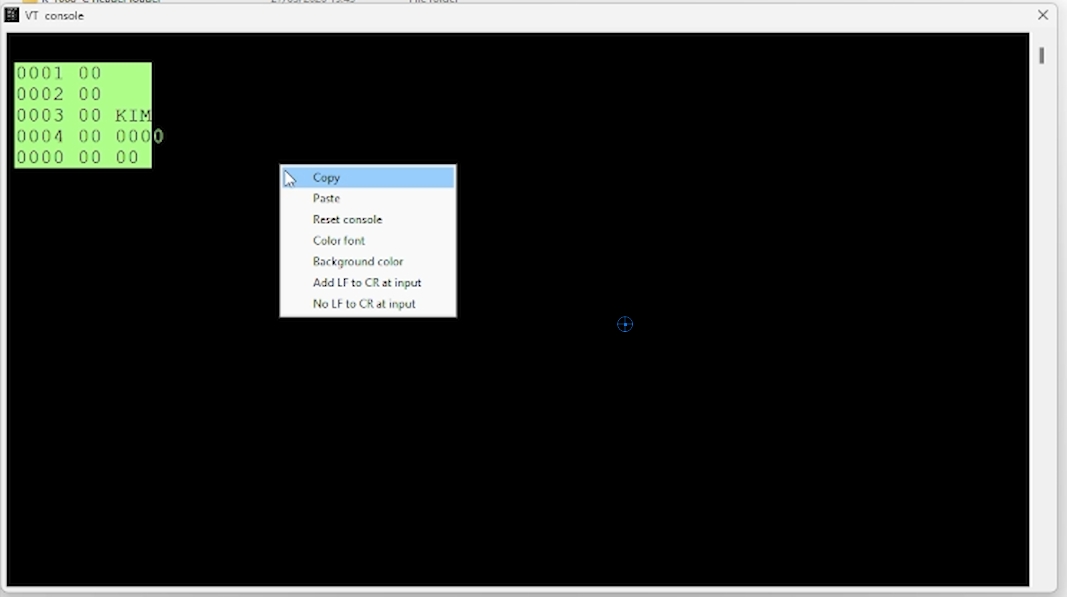
A demo of the new facilities in the KIM-1 Simulator 2.2.1
KIM-1 connectors: beware the Chinese cheap variants!
Magazines: Compute! and Compute II