
KIM-1 expansions in Radio Bulletin”
My KIM-1 system was based upon what we had published in Radio Bulletin. These articles by Dick de Boer, Paul de Beer and me document how the expanded system evolved, using an extended version of the BEM bus.
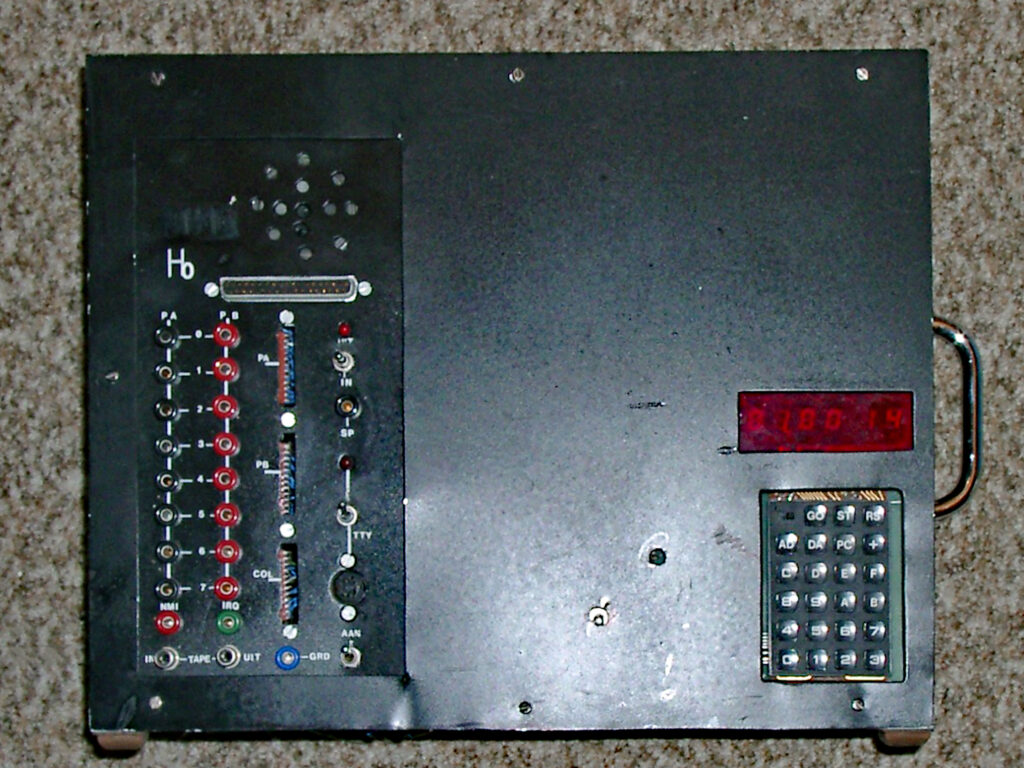
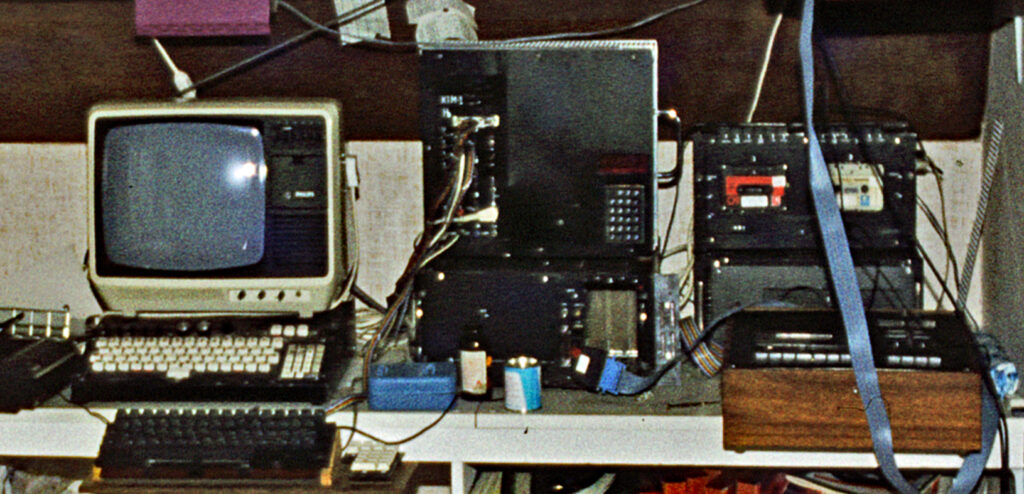
Articles here:
- The KIM-1
- Write your own programs
- Programming step by step
- Memory expansion for the KIM
- EPROM Programmer
- Tinkering wih a Casssete deck
- Memory expansion for the KIM 4K RAM
- Motherboard for 6502 systems
- ACIA6850 Serial in- and output
- Parallel in- and output PIA 6820 and and VIA 6522
- Mini-digital Cassetterecorder interface for the 6502
- 4K EPROM card
- Graphical TV Display
- Letters (Characters) on the Graphical TV Display
- Lines on the Graphical TV Display
- ASCII characters on the Graphical TV Display
- Graphical TV Display Monitor
- Digiscope for 6502 systems
- 48K Dynamic RAM card
- 48K RAM card for 6502 systems
De KIM-1
The article that started the KIM-1 articles!
 |
De KIM-1 Radio Bulletin Augustus 1977 Original article |
|
The KIM-1 RB Aug 1977 English |
|
De KIM-1 RB Aug 1977 Dutch |
Write your own programs
Radio Bulletin September 1977
The most enjoyable work is of course writing your own programs, making the KIM I do exactly what you want. Now, programming is not that easy for someone who has never done it before. Especially at the beginning, the aspiring programmer works in such a disorganised way that in the end he no longer knows which instruction is at which address. It is therefore important to set up a program in a clear, orderly way and to write down every change. In this article we will use an example to show how this is done. However, we leave the exact working-out to the reader, because here too it is certainly true: practice is the best teacher!!!
 |
Zelf programmas maken Radio Bulletin september 1977 Original article |
|
Writing your own programs English RB Sept 1977 |
|
Zelf programmas maken Dutch |
Programming step by step
A five part article in Radio Bulletin 1978 to 1979
Since RB’s KIM campaign in August of last year, the number of KIM owners has grown considerably. Readers’ reactions show that some of the new KIM owners are already getting the hang of programming quite well. Another group, however, is clearly lagging behind: the people who cannot find the ‘beginning’. That is very understandable when you consider that, although the computer is built from electronics, programming is completely new territory for many. In this article RB will therefore try to help this group on their way.
 |
Programmeren stap voor stap Radio Bulletin 1978 to 1979 |
|
Programmeren stap voor stap Dutch |
|
Programming step by step English |
/ |
Programming step by step sources |
Memory expansion for the KIM
Radio Bulletin 1977/ Introduction of the BEM bus with a 1K RAM card.
Although the 1K memory space of the KIM 1 is very generous for a beginning programmer, sooner or later the need for more memory will arise. This allows larger programs to be written, or more programs to be held in memory at the same time.
There are several ways to expand the memory. You can buy a number of ICs yourself and mount them on a home-made circuit board, which is by far the cheapest solution. The nicest solution is simply to buy a ready-made memory card; you then have a professional piece of work, with the reliability that goes with it.
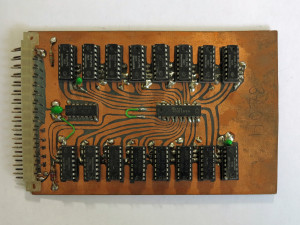
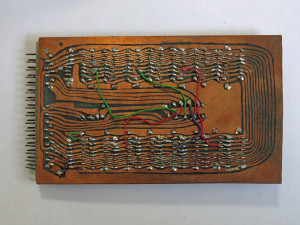
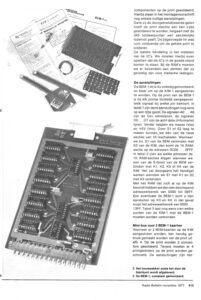
A 1K EPROM card is designed, based upon the BEM bus.
 |
Geheugenuitbreiding voor de KIM Radio Bulletin November 1977 Original article |
|
Memory expansion for the KIM RB Nov 77 English |
|
Geheugenuitbreiding KIM Dutch |
|
Memory expansion for the KIM source and binary |
EPROM Programmer
Radio Bulletin 1978 J.M. v.d. Peijl
The EPROM (Erasable PROM) can also be programmed by the user. In addition, it can be erased again using ultraviolet light. Thus an EPROM containing obsolete or outdated programs can simply be erased and reprogrammed. The most popular EPROM at present is the 2708 (1K byte), which has fallen considerably in price recently, partly because of its successors, the 2716 and 2732, with 2K and 4K bytes respectively. Programming such an EPROM is a task that the KIM can handle very well. In this first part you can read how, by adding a few simple circuits, the KIM takes over the job of an expensive PROM programmer. We will describe several practical versions.
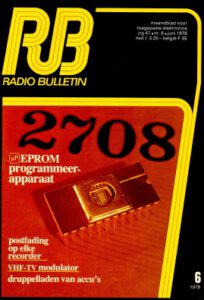 |
Eprom programmeer apparaat Radio Bulletin Juni Juli 1978 original article |
|
EPROM programmer Radio Bulletin June July 1978 English |
|
Eprom programmeer apparaat Radio Bulletin Juni Juli 1978 Dutch |
|
Eprom programmer source and binary Radio Bulletin Juni Juli 1978 Dutch |
Audio cassette recorder
Radio Bulletin March 1980
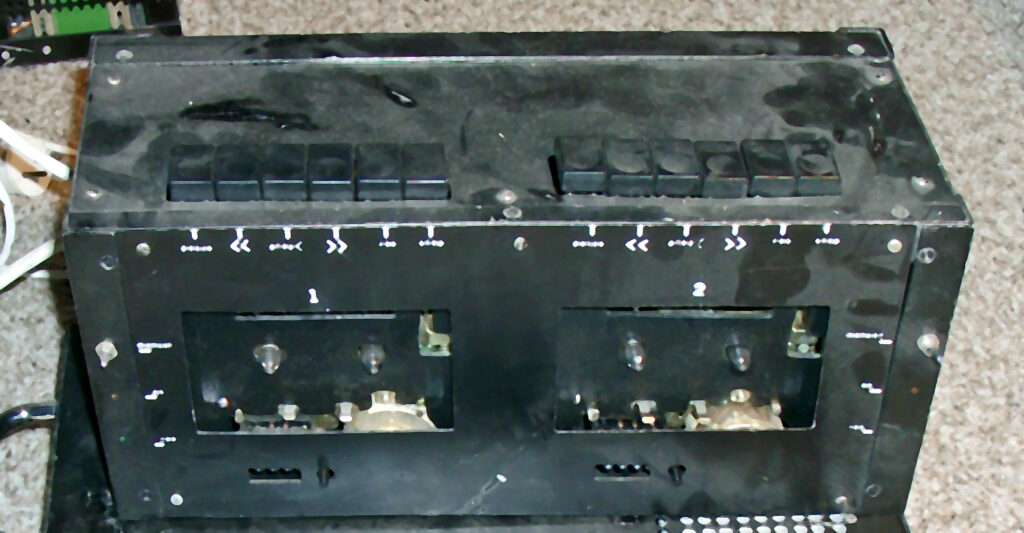
Accompanied by the slogan ‘Tophit 1980’, Radio-Service Twenthe is offering a built-in front-loader cassette deck for the low price of f 32.50. Radio-Service Twenthe often manages to offer interesting industrial surplus to the amateur at a reasonable price, and this cassette deck is another example of that. A handy tinkerer can easily turn this cassette deck into a mono cassette recorder; for personal computer users this is a golden opportunity to get hold of suitable cassette recorders with a tape mechanism.
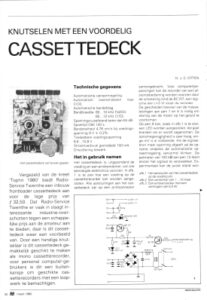 |
Knutselen met een cassettedeck Radio Bulletin maart 1980 original article |
|
Tinkering with a cassettedeck RB March 1980 English |
|
Knutselen met een cassettedeck RB March 1980 Dutch |
Memory Expansion for the KIM
With 4K RAM card and busbuffer print.
Radio Bulletin September October 1979
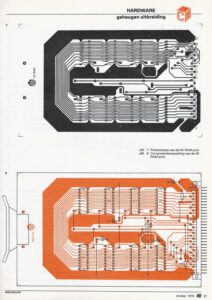
Memory expansion for the KIM has already been discussed twice. The first time, in the November 1977 issue, it was shown how RAM could be added with the BEM-1 board, a kit for 2K of static RAM. The second time was in the July 1978 issue, when a board design for a 2K EPROM card was published, with the same bus connections as the BEM-1 card. This series now continues with a 4K static RAM board, also with the same bus. Connecting the RAM to the KIM requires address decoding and a bus buffer. A board has been designed for this as well.
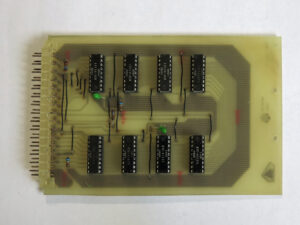
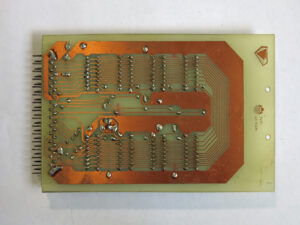
The 4K RAM production.
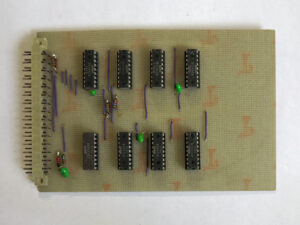
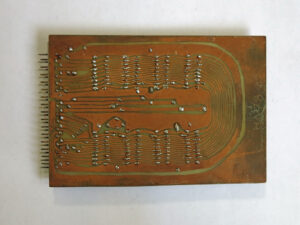
The 4K RAM prototype.
 |
Geheugenuitbreiding voor de KIM Radio Bulletin September October 1979 Original article |
|
Memory expansion English |
|
Geheugenuitbreiding Dutch |
Motherboard, memory support for 6502 systems
Radio Bulletin July 1981
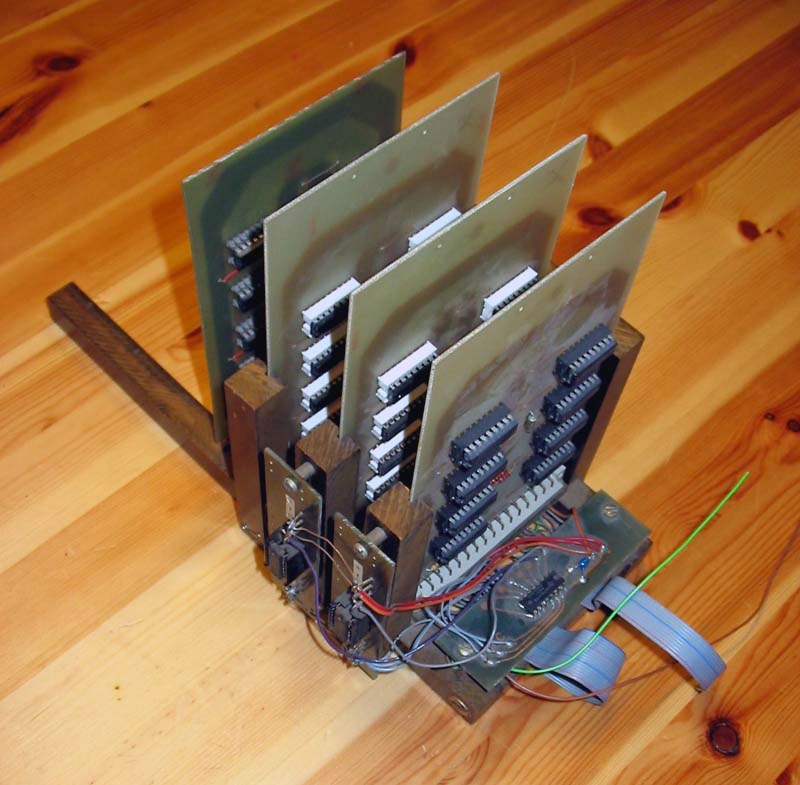
Radio Bulletin has already described several ways to expand the standard memory of 6502 systems such as the KIM. Published so far are a 2 Kbyte static RAM card, the BEM-1 board (November 1977), a 2 Kbyte EPROM card (June and July 1978) and a 4 Kbyte static RAM card (September and October 1979). All these designs use the bus as used on the BEM-1 board, but with a number of additions, which will be needed mainly for the 4 Kbyte EPROM board in a forthcoming issue. This article describes a motherboard into which all these cards can be plugged.
 |
Moederprint for 6502 systems Radio Bulletin Juli 1981 Original article |
|
Motherprint for 6502 systems English |
|
Moederprint voor 6502 systemen Dutch |
Parallel in- and output PIA 6820 and and VIA 6522
Radio Bulletin May 1984
The subject of this article is a family of parallel input/output ICs: the PIA 6820, 6821, 6520 and the VIA 6522. These are widely used ICs, and not only in 6500 and 6800 microprocessor systems. Besides the general hardware characteristics of the PIA and the VIA, a practical implementation is presented
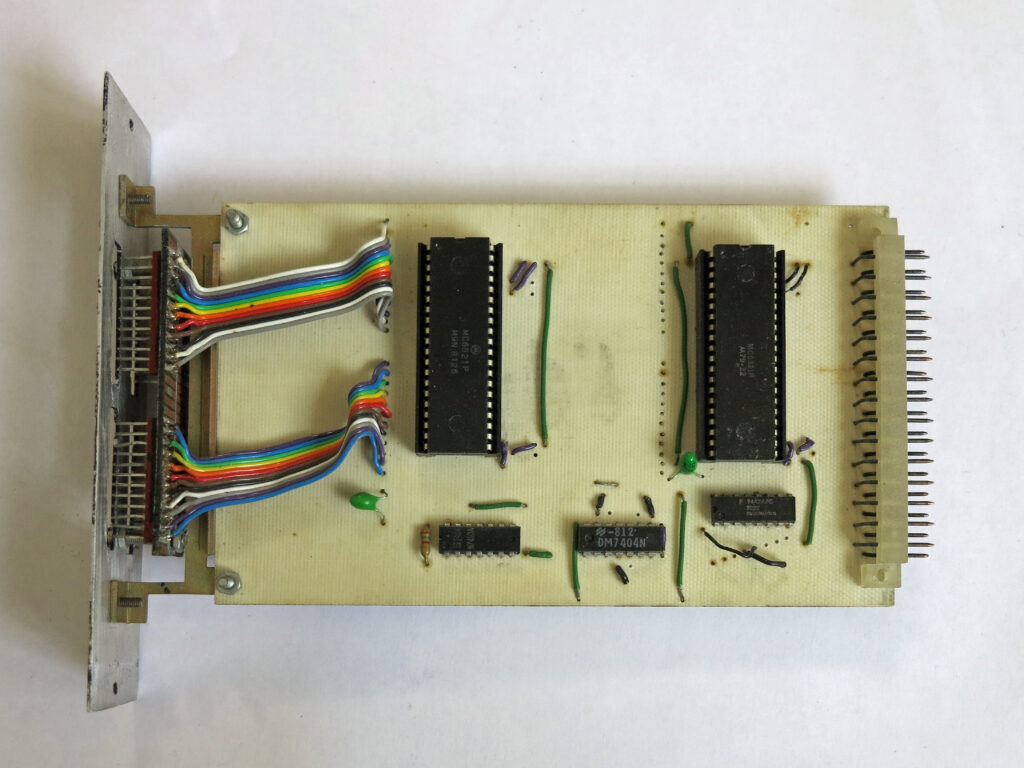
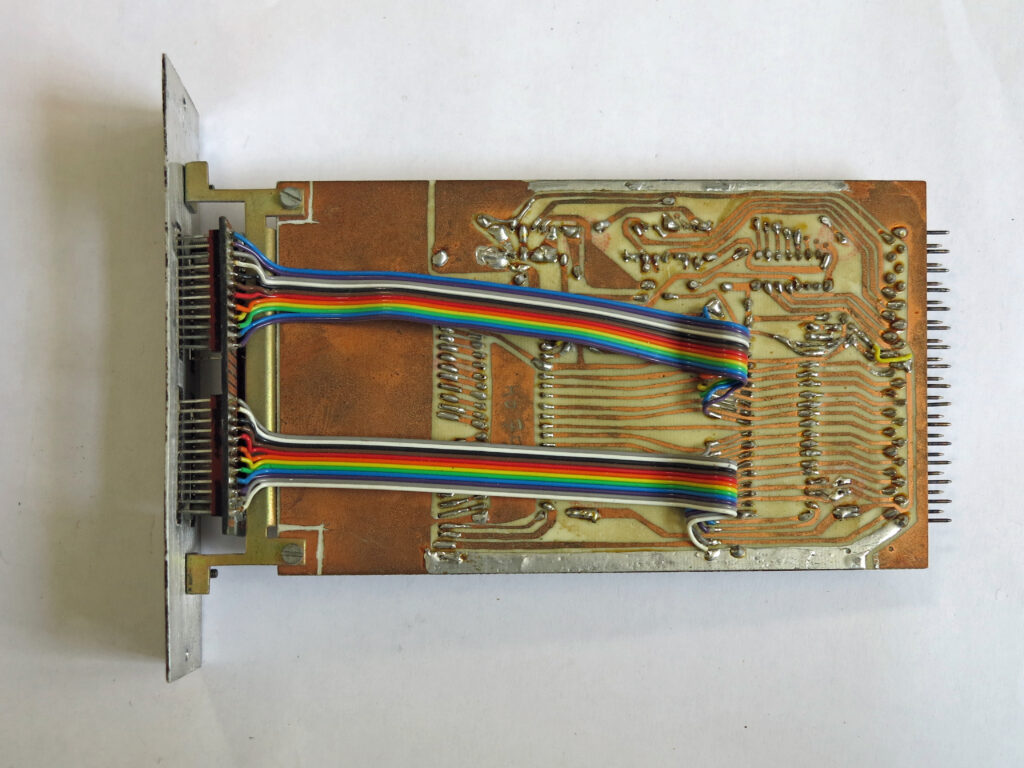
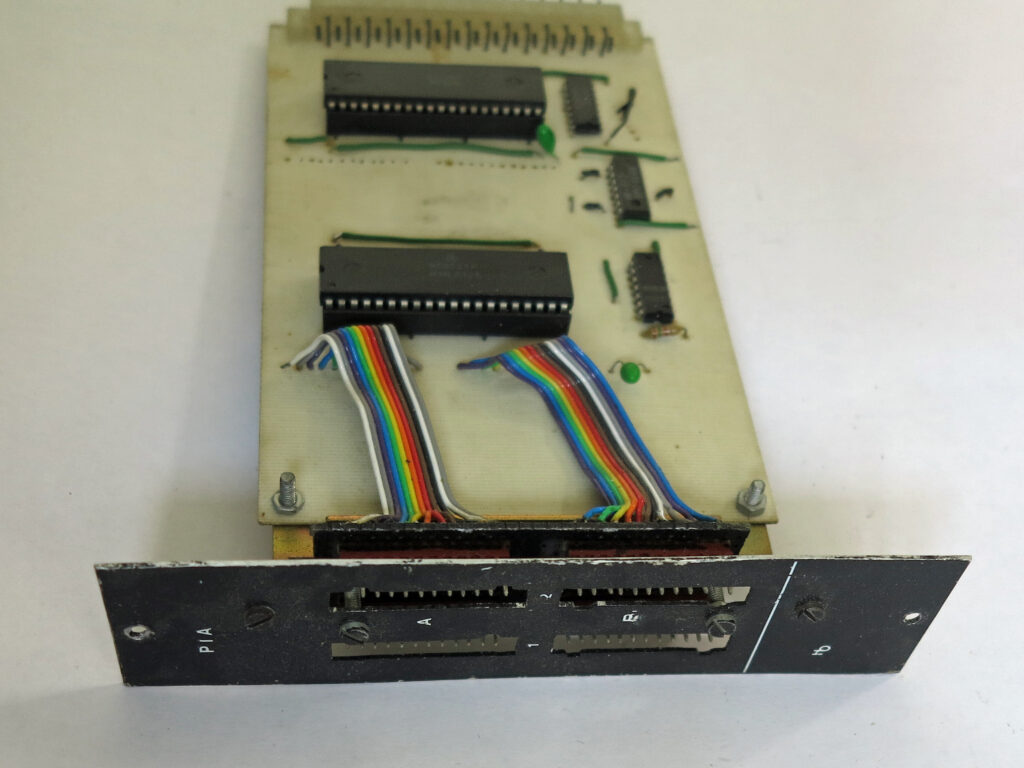
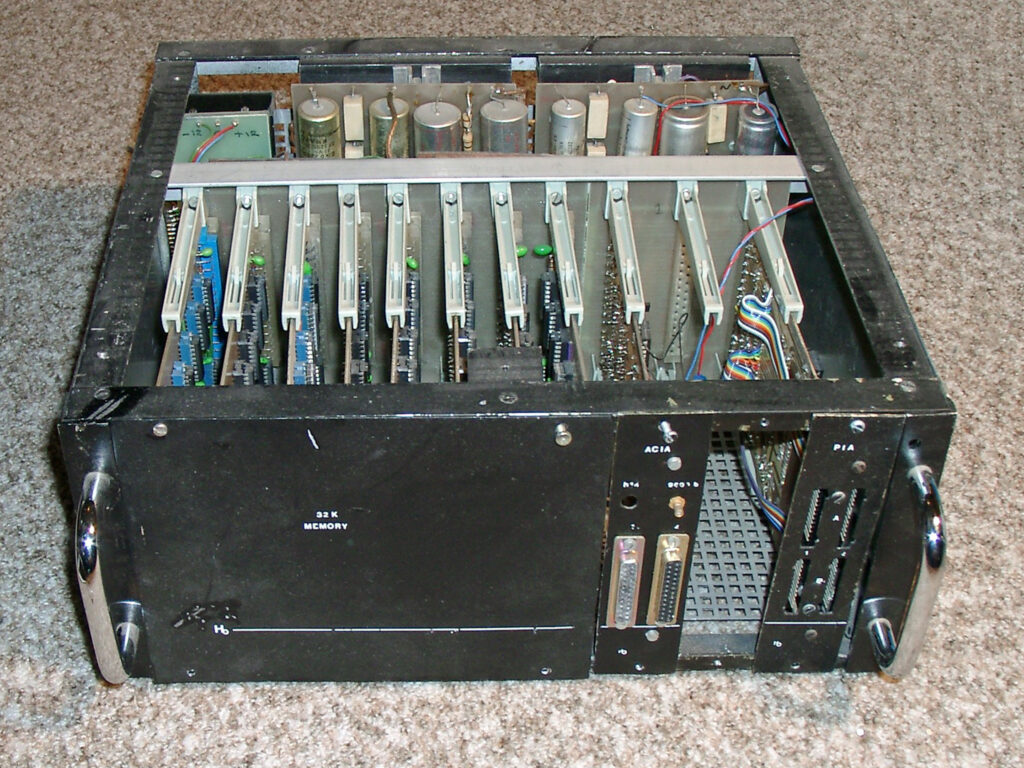
Prototype of PIA VIA card
 |
Parallele in- en uitvoer VIA en PIA Radio Bulletin May 1984 Original article |
|
Parallel in- and output English |
|
Parallele in- en uitvoer Dutch |
ACIA6850 Serial in- and output
Radio Bulletin September October November 1983
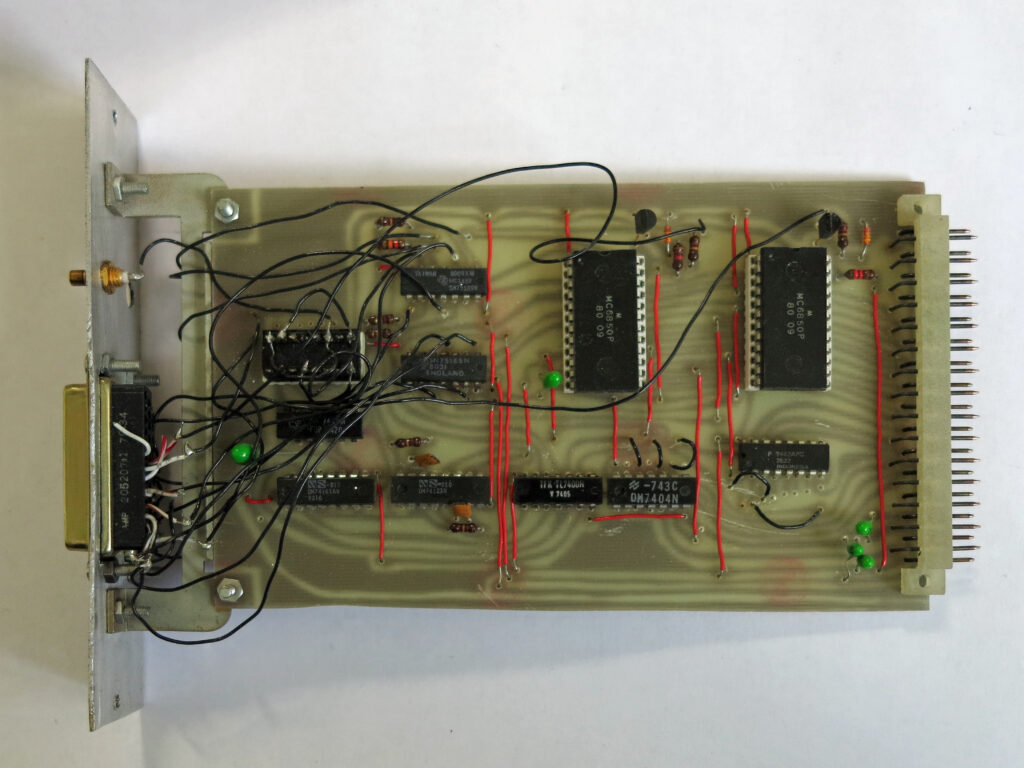
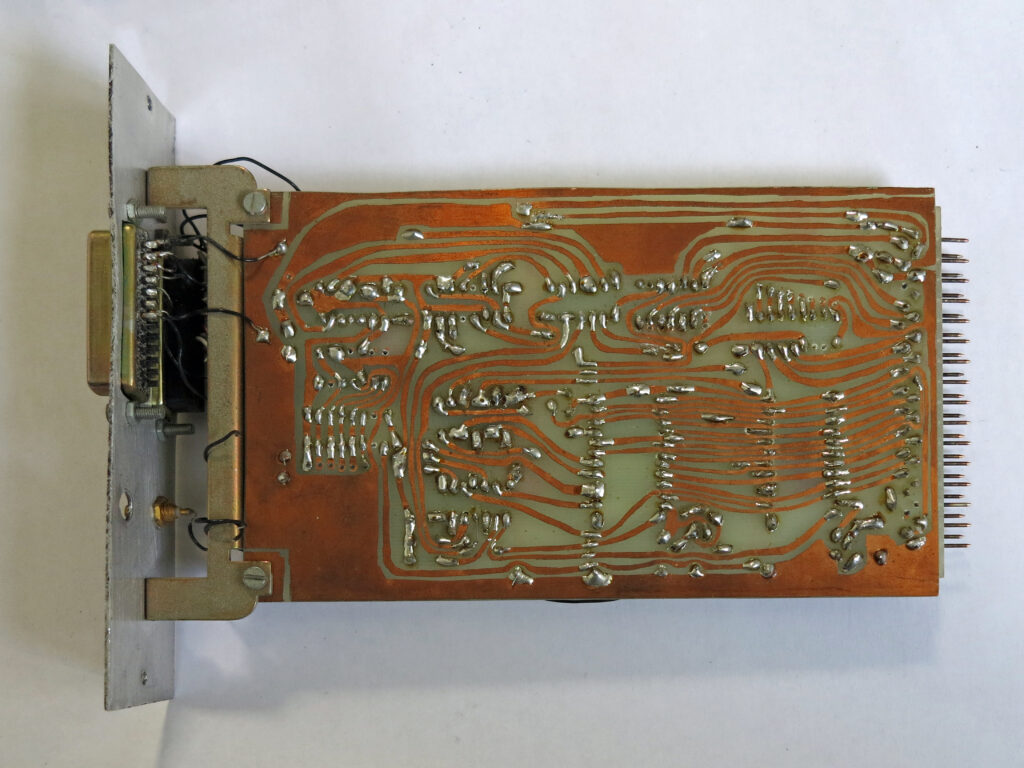
Prototype serial interface
 |
ACIA6850 Seriele in- en uitvoer Radio Bulletin September – November 1983 |
|
ACIA6850 Serial in- and output RB sept oct nov 1983 Dutch |
|
ACIA6850 Serial in- and output RB sept oct nov 1983 English |
|
ACIA6850 examples source |
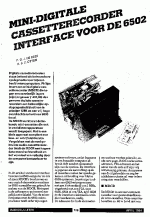
Mini-digital cassette recorder interface for the 6502
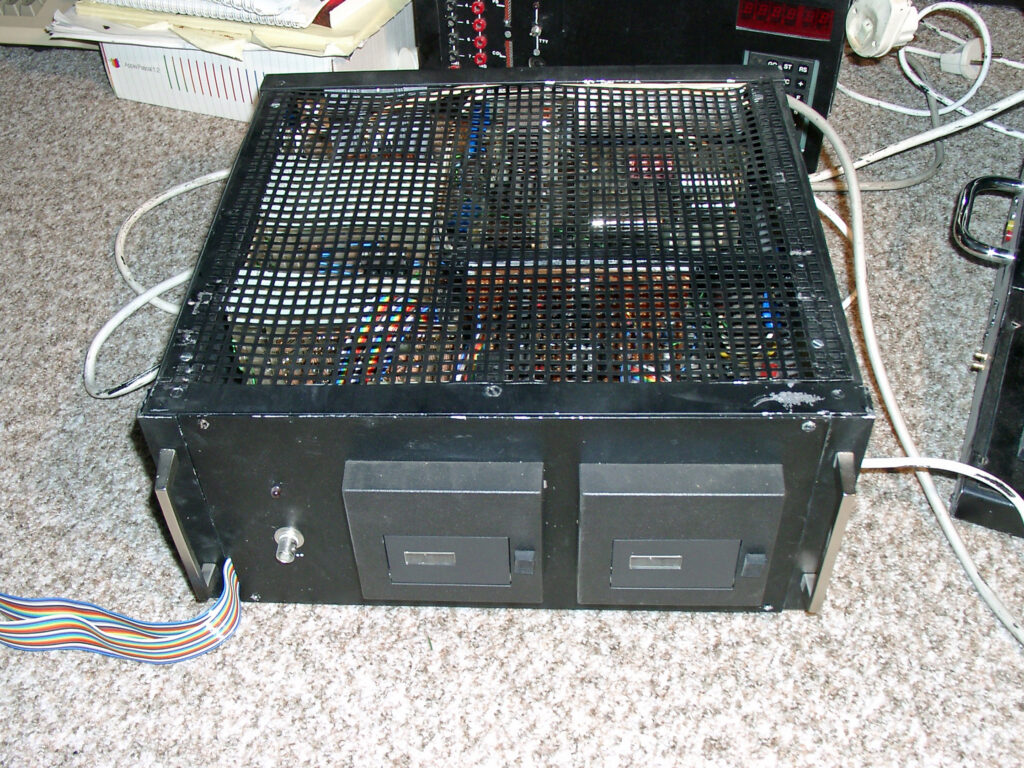
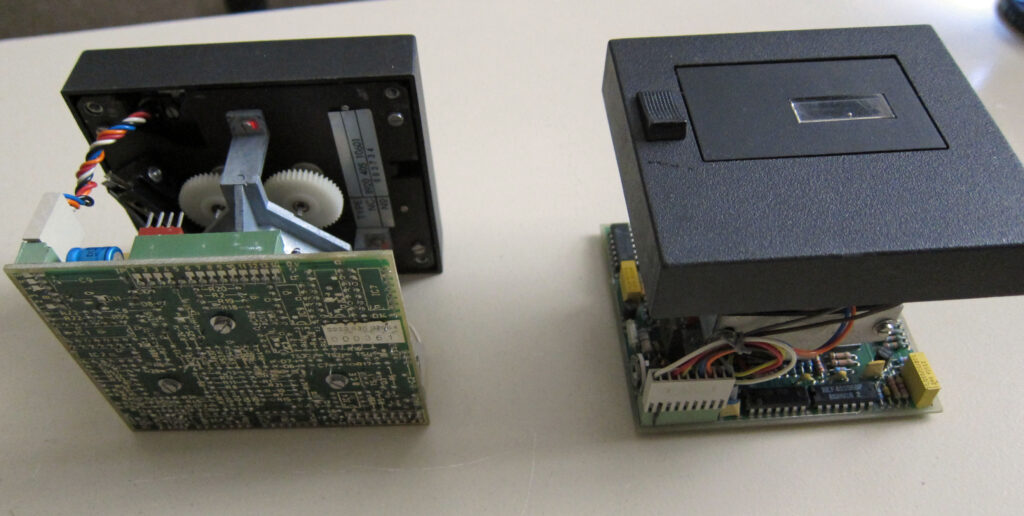
This article describes an interface between a 6502 computer and one or more MDCRs, and a number of elementary routines in 6502 assembler for using the MDCR. The software has deliberately been developed to be as universal as possible
 |
MDCR voor de 6502 Radio Bulletin April 1984 original article |
|
MDCR for the 6502 RB April 1984 English |
|
MDCR voor de 6502 RB April 1984 Dutch |
|
Mini-digital interface MDR source With original listing as scan |
|
Philips-MDCR_Service-Manual |
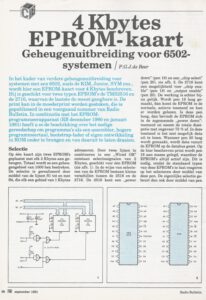
4K EPROM card
Radio Bulletin September 1981
As part of further memory expansion for 6502-based systems such as the KIM, Junior, SYM, etc., a 4 Kbyte EPROM card is described here. It is suitable for two types of EPROM, the TMS2516 and the 2716, the latter being the most common. The board plugs into the motherboard published in a previous issue of Radio Bulletin. Combined with the EPROM programmer (RB December 1980 and January 1981), this gives you the tools needed to put programs such as an assembler, a high-level programming language, a bootstrap loader or your own developments into ROM and run them from there.
 |
4 Kbytes EPROM-kaart Radio Bulletin september 1981 Original article |
|
4K EPROM Card English |
|
4K EPROM Kaart Dutch |
Graphical TV Display
Radio Bulletin, 4 parts, September 1978 – November 1978 – February 1979 – March 1979
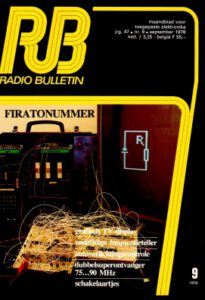
Just imagine: an ordinary TV on which you can make your own drawings. These can range from plain text and graphical representations of mathematical functions to a drawing made by a toddler. For this purpose the TV screen has been divided into a grid of 256 × 256 dots!! Such a grid gives roughly the maximum resolution that can be displayed on an ordinary TV (without interlacing). The applications are countless. The computer hobbyist gets a particularly fine output device, a kind of combination of plotter and teletype. For those who do not own a computer, it is possible to expand this unit into a hobby computer.
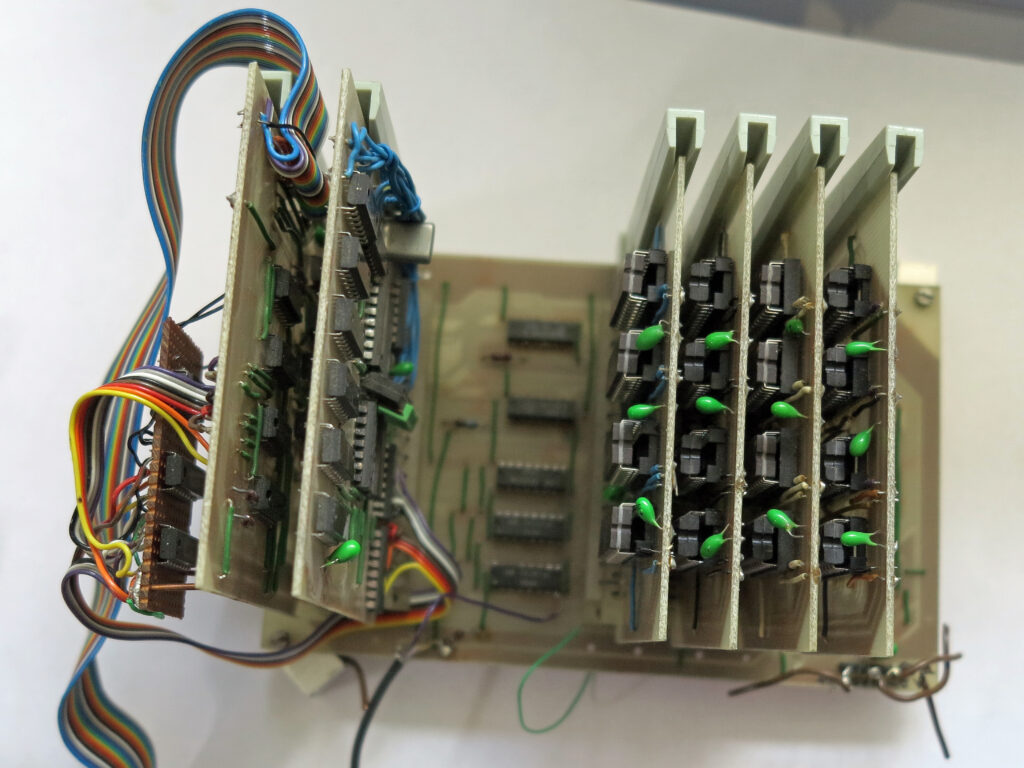
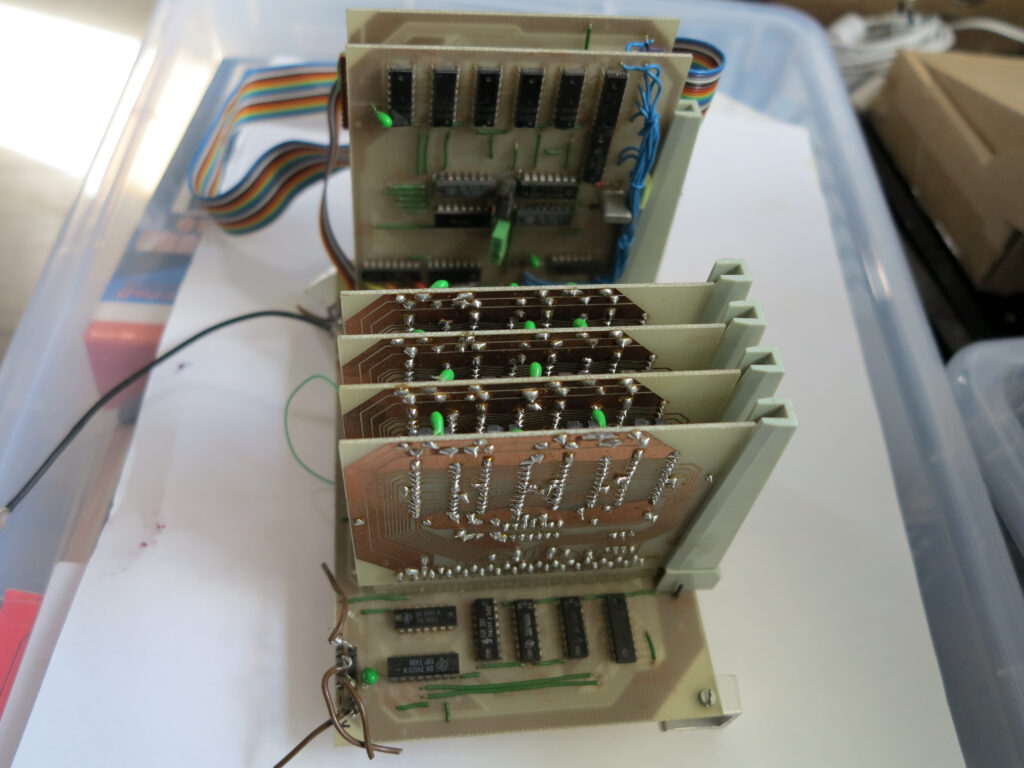
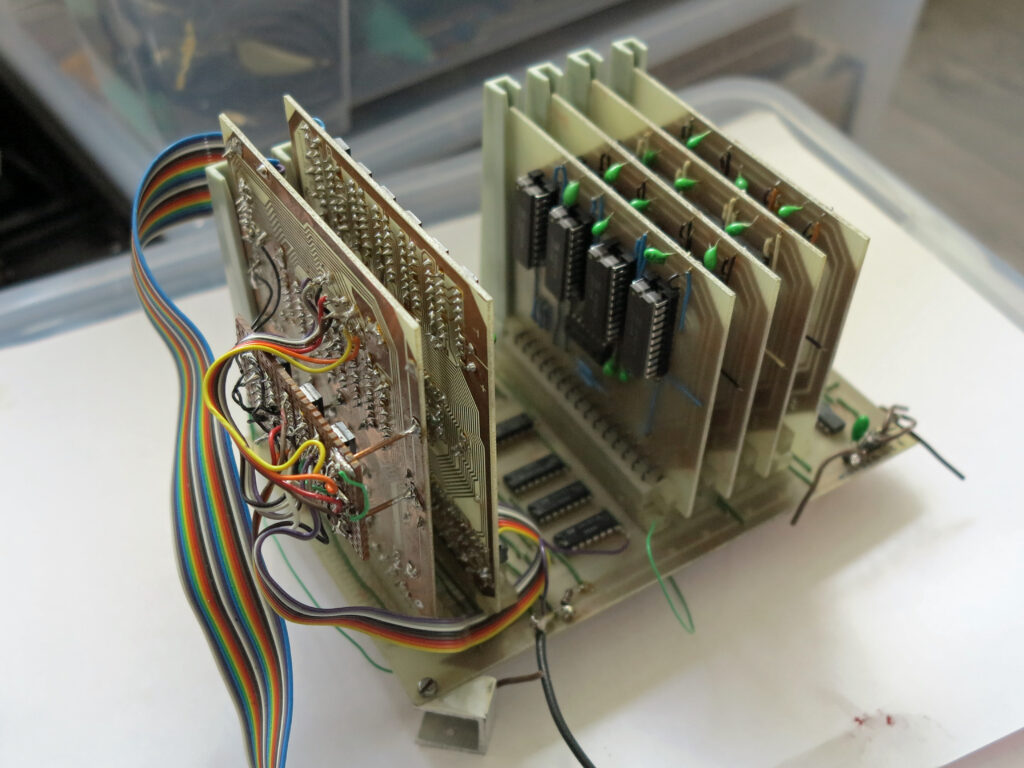
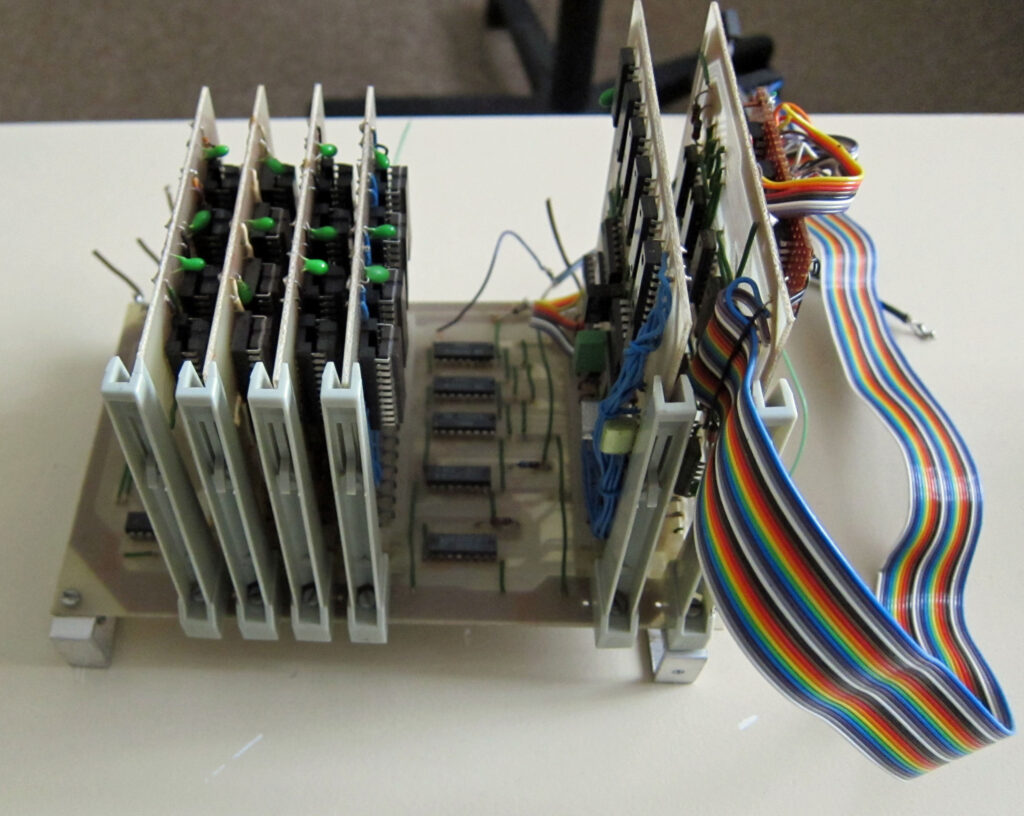
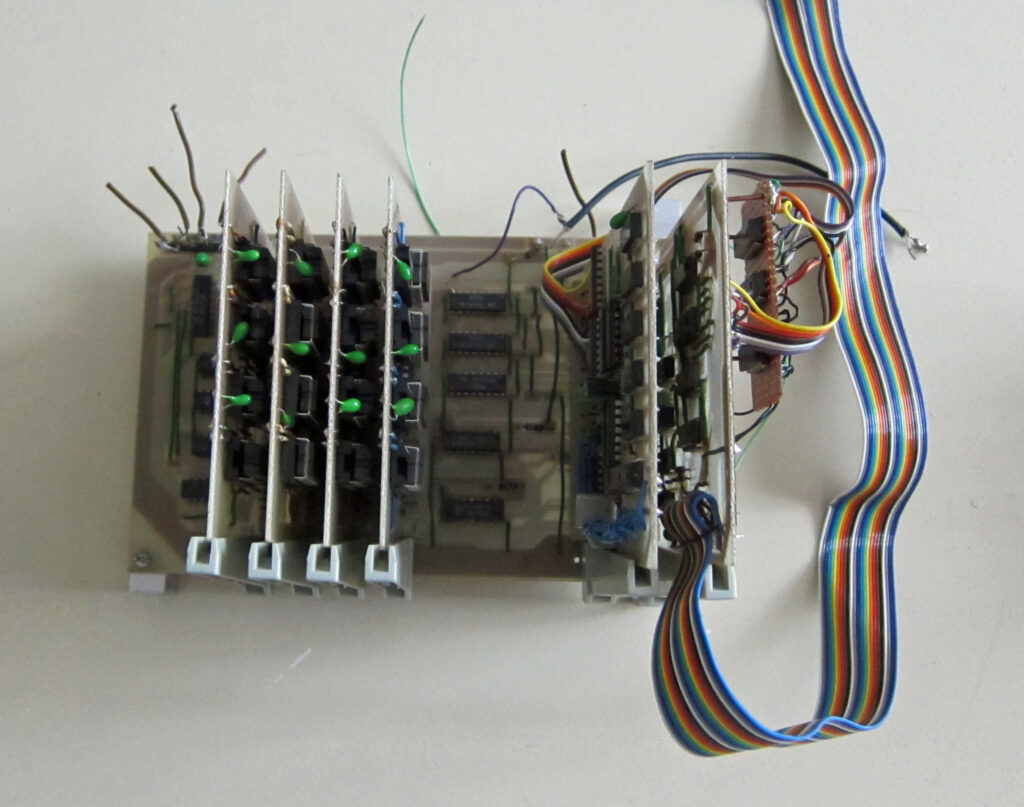
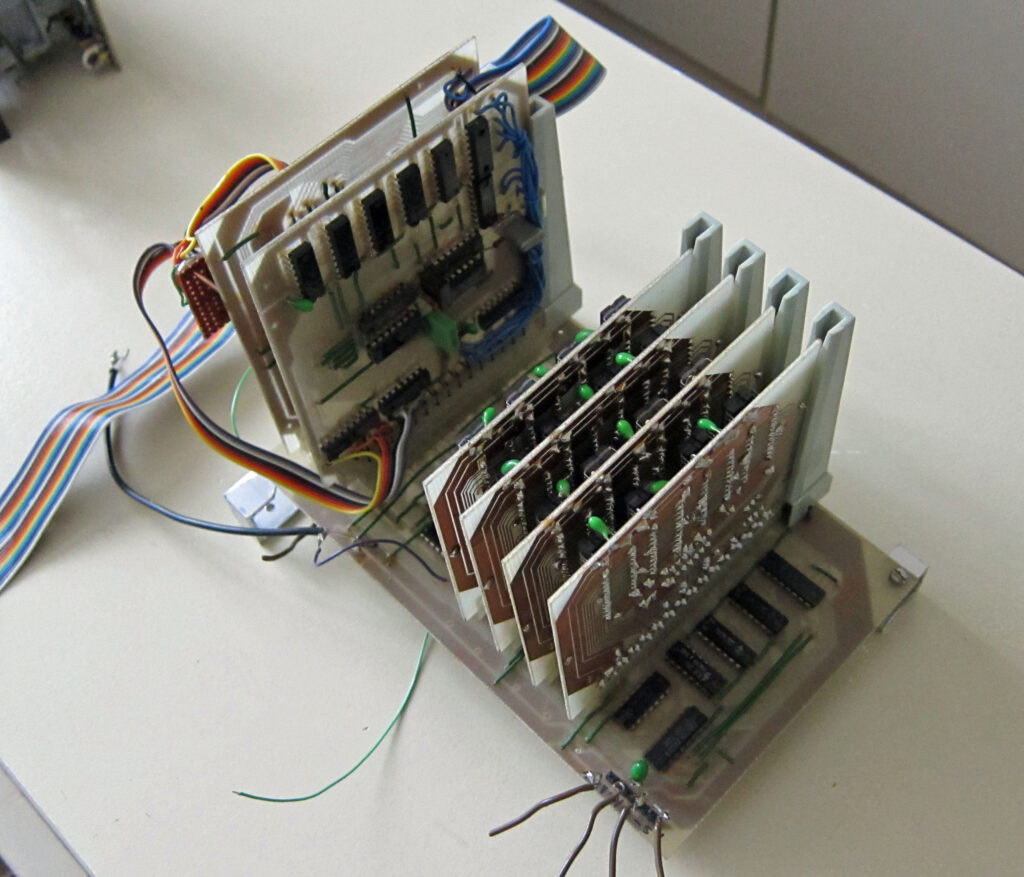
My Graphic Dispkay with the hardware scroll addition.
 |
Grafisch TV-display Original articles Radio Bulletin 1978 1979 |
|
Graphical TV Display English |
|
Graphical TV Display Dutch |
ASCII characters on the Graphical Display
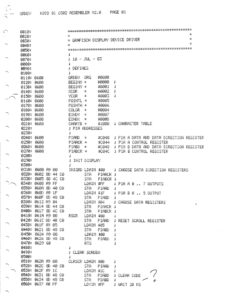
A subroutine to display an ASCII character (upper and lowercase) on the Graphical Display.
Unpublished code, 1983 Hans Otten
 |
GRDEV source full ASCII set/a> |
Characters (Letters) on the Graphic Display
Radio Bulletin May June July 1981
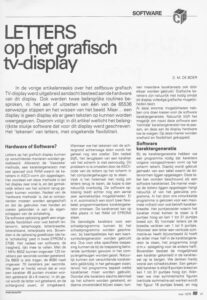
In the previous series of articles on the home-built graphic TV display, a lot of attention was paid to the hardware of this display. Two important routines were also discussed, namely switching on or off one of the 65536 dots and clearing the picture. But… a display is not a display if no text can be shown on it. That is why this article presents what is perhaps the most important piece of software written for this display: ‘drawing’ letters, with unprecedented flexibility.
 |
Letters op het grafisch display Radio Bulletin mei juni juli 1979 Original article |
|
Letters on the Graphical Display English |
|
Letters on the Graphical Display Dutch |
|
Characters on the graphic display sources |
Lines on the Graphical Display
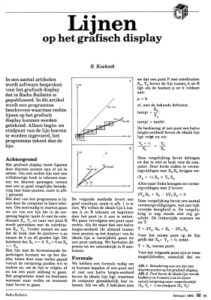
This article describes a program that draws straight lines on the graphic display. Only the start and end points of the line need to be entered; the program then draws the line.
 |
Lijnen op het grafisch display Radio Bulletin Februari 1982 Original article |
|
Lines on the graphic display English |
|
Lijnen op het grafisch display Dutch |
|
Lines on the graphical display sources |
Graphical Display Monitor
Radio Bulletin 1981 – 1984 4 parts
The set-up is as follows. The complete package consists largely of subroutines that are controlled by a small main program. These routines are simply placed one after the other in memory. Those who do not want a complete monitor can use these subroutines separately, since they can also prove their worth on their own. This produces a “subroutine arsenal”. Those who do want a complete machine-language monitor, however, will have to make a few changes to, and additions to, the hardware.
1. As you may know, it is possible to build a hardware scroll-up on the GD. This needs 4 ICs. Without this extension the monitor does not work.
2. The monitor needs a larger keyboard (28 keys). I may assume, however, that if you do not have an ASCII keyboard you have long been planning to buy a more extensive keyboard. Further on in this article a keyboard is described that is very cheap and more than adequate (for about f 30.00 you have a well-working keyboard). A real ASCII keyboard is of course still recommended.
3. Not necessary, but very handy, is a circuit that allows a loudspeaker to be switched on and off by software. This can be useful in combination with the monitor (think for example of a beep after CRLF has been given).
 |
Grafisch display monitor voor de KIM Radio Bulletin 1979 1981 original rticle |
|
Graphic display monitor for the KIM English |
|
Graphic display – monitor for the KIM Dutch |
|
Graphical display monitor KIM sources |
Digiscope for 6502 systems
Radio Bulletin April 1983
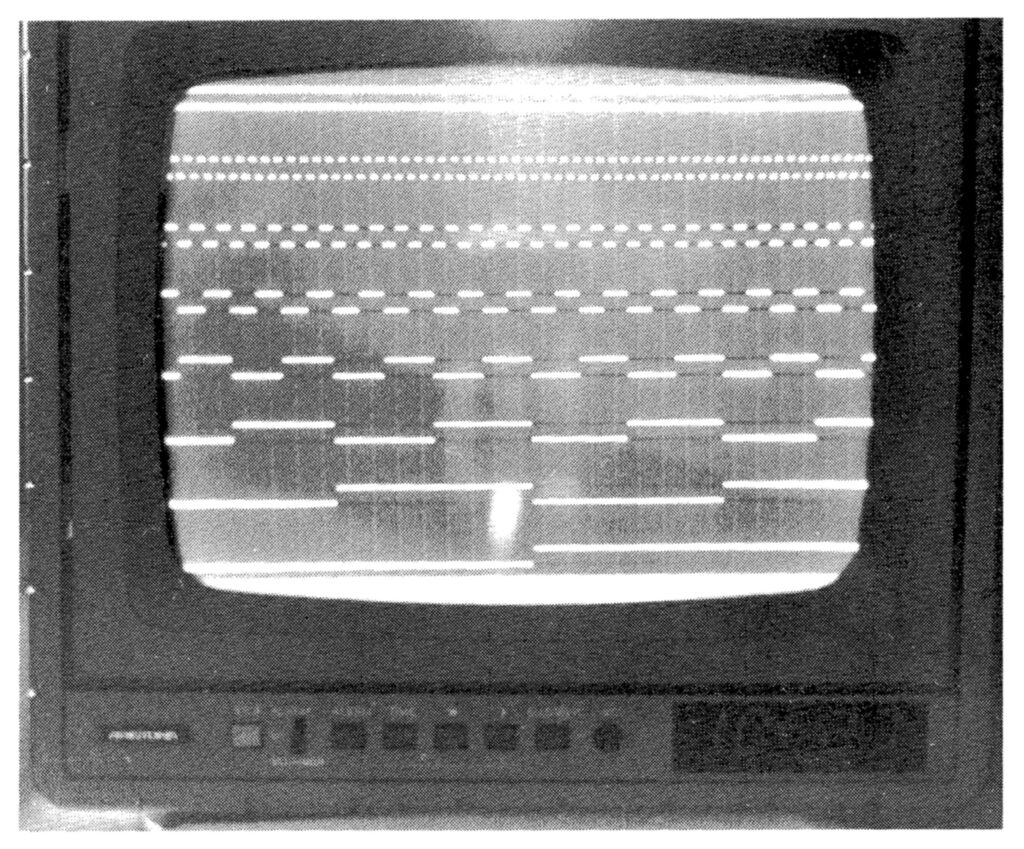
Those who have a Graphic Display and a computer system based on the 6502 will discover in this article that the possibilities of this combination are almost unlimited. The January 1980 issue described a frequency meter, which once again showed that a computer can prove its worth in the hobbyist’s electronics lab. The program discussed here, as an addition to the frequency meter, will for many be an answer to the question: “Should I buy a computer?” What we have here is a so-called “digiscope”. This is a kind of oscilloscope that makes digital signals visible on the graphic display.
>
 |
Digiscope voor 6502 systemen Radio Bulletin April 1983 Original article |
|
Digiscope for 6502 systems RB April 1983 English |
|
Digiscope for 6502 systems RB April 1983 Dutch |
|
Digiscope for 6502 source |
48K RAM card
Radio Bulletin 1982
If you want to work with Basic, Forth, editors etc., you need a lot of memory. It makes no sense to build this up from 4K memory cards. A cheaper and better solution is to use dynamic RAM ICs.
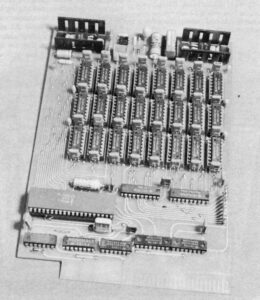
The industry-standard 4116 is a 16K × 1 dynamic RAM chip. With eight of these 16-pin ICs you get 16 Kbyte, and with 24 ICs 48 Kbyte. The dynamic RAM card for the 1802 fits into a bus connector of the Cosmicos computer. The card is also easy to use with other 1802 systems; it is then connected with 24 wires.
What is remarkable is the simplicity of the dynamic RAM card. This is because a special IC has been used for timing and refresh: the Intel 8202. Since this controller and the memory ICs functionally form a self-contained unit, use with e.g. KIM or Junior computers is certainly possible by adapting the addressing logic. You don’t need to design a PCB for that part – no small job saved.
 |
48K RAM card for 1802 systems Original article, Cosmicos series |
|
Cosmicos 48K dyn ram card English |
|
Cosmicos 48K dyn ram kaart Dutch |
48K RAM card Interface for the 6502
Radio Bulletin September 1983
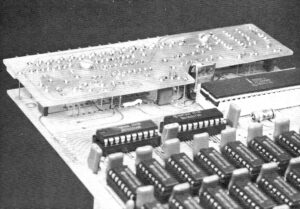
After tinkering for some time with 4K RAM cards and the accompanying tangle of wires
and connections, my eye was caught by the 48K RAM card for the 1802 published in the
March 1982 and following issues of RB. This o%ered the chance to solve the memory
problem once and for all, so the possibility of adapting this card to the 6502 processor
was studied. By leaving a number of ICs o% the original board and adding a small
interface in the space freed up, you get 48K of RAM for your 6502 system – a real wealth.
 |
48K ram kaart voor de 6502 Radio Bulletin September 1983 Original article |
|
48K ram card voor 6502 English |
|
48K ram kaart voor 6502 Dutch |