
On the page KIM-1 Memory layout you can see the KIM-1 in its basic form of address decoding is limited to 8K address space, repeated 8 times in the 64K address space.
So the KIM-1 can boot from the KIM-1 ROM since address 17FA is the same as FFFA.
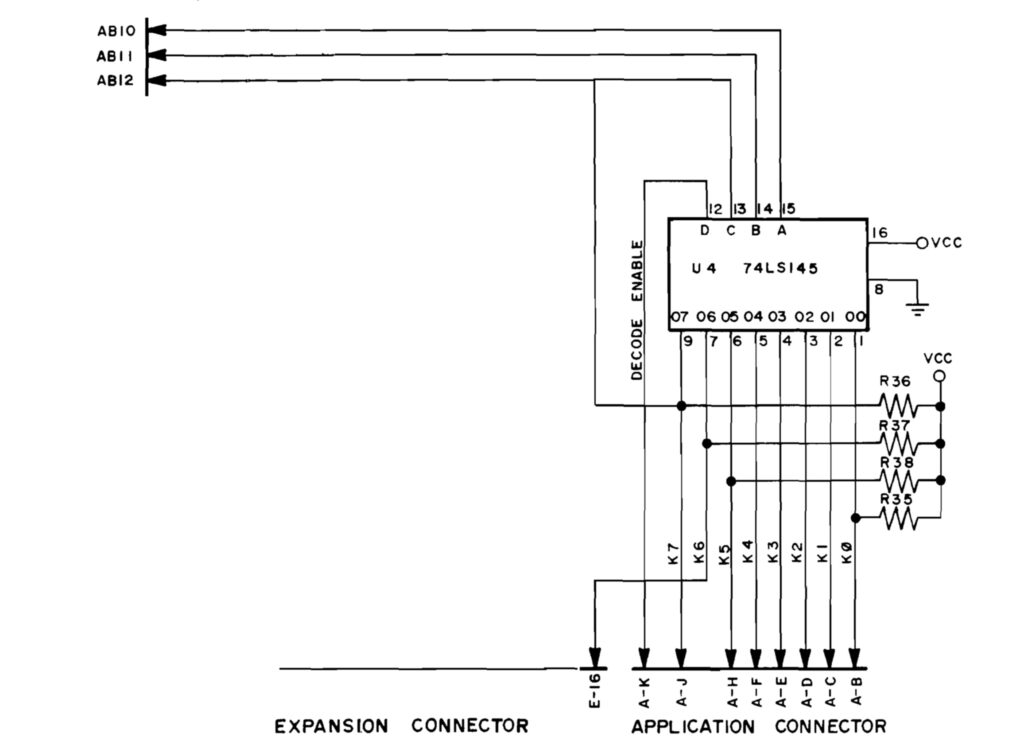
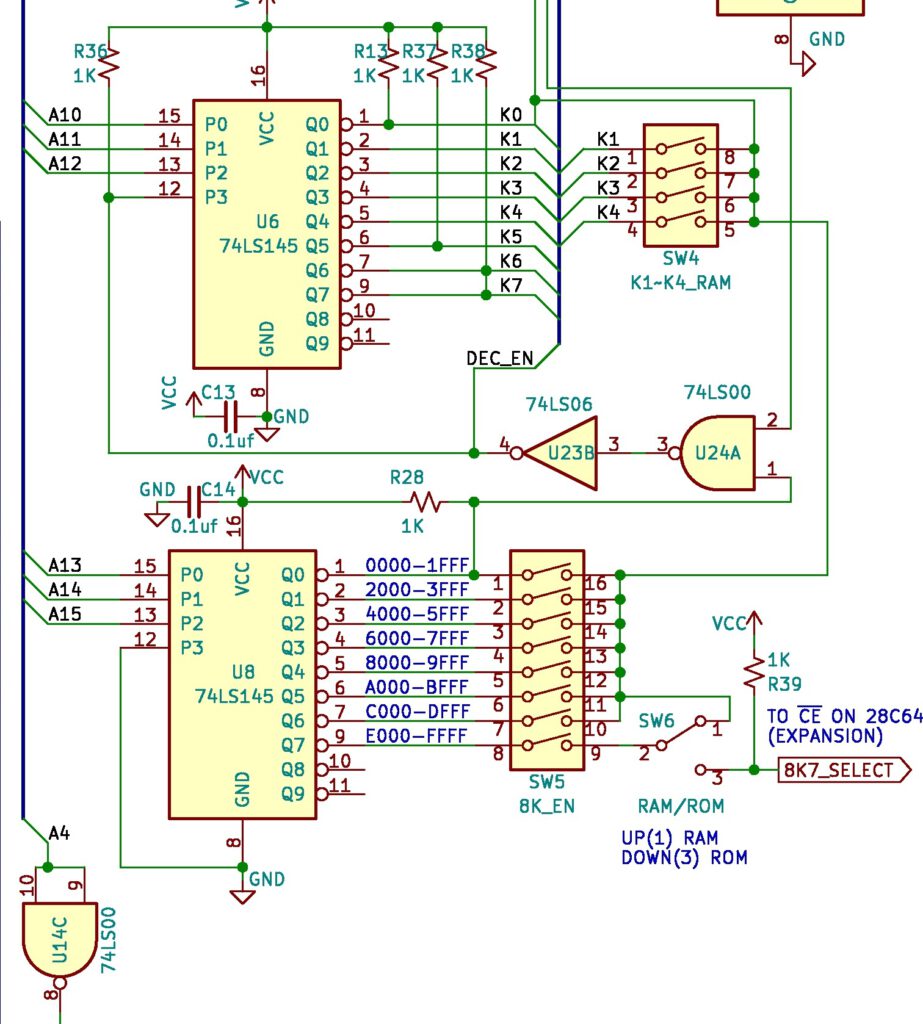
The basic memory decoder in the KIM-1
Simple expansion
A first memory expansion often used in the KIM-1 is to use K1, K2, K3 and K4. When you place RAM there, location 0400-13FF become available. The KIM-1 still sees 8K repeated in the 64K
My first expansion was made this way, four 1K SRAM cards made 4K RAM extra available. Great for Tiny Basic.
This is described in the Radio Bulletin article with the 1K B.E.M. static RAM card.
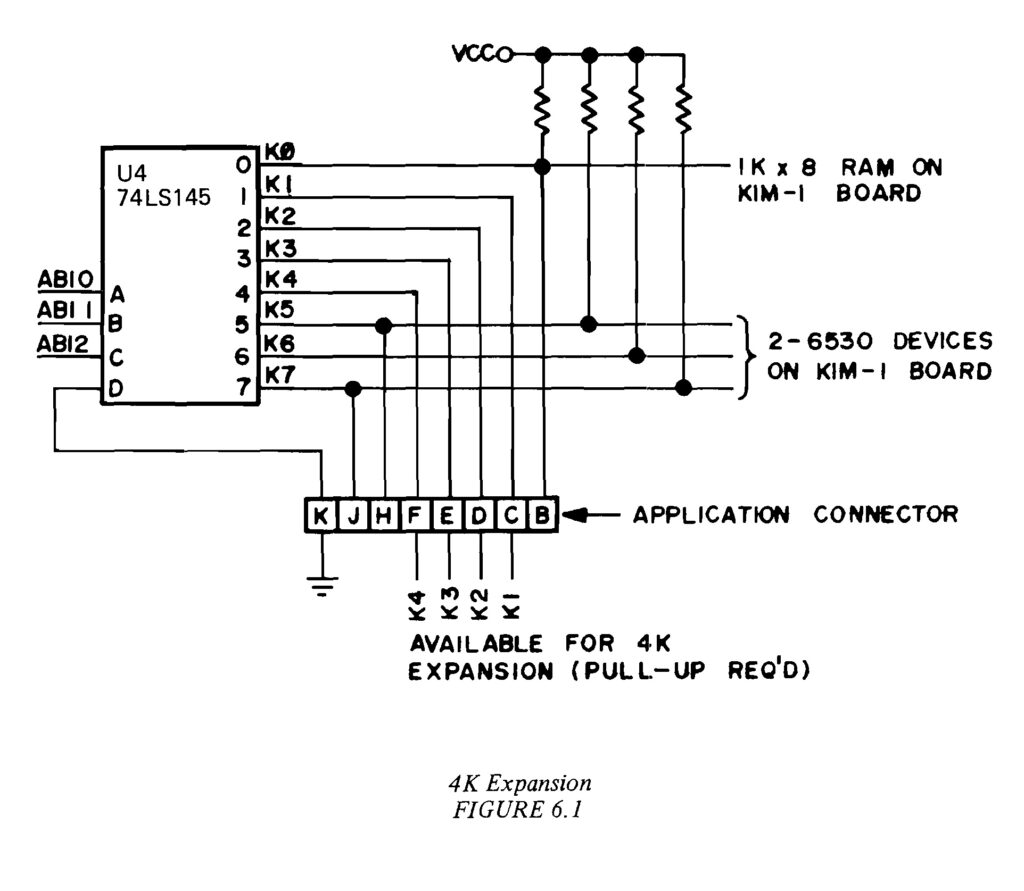
Chapter 6 of the User manual has good advice on the memory decoding.
If we want to expand the access of the 6502 to more than *K , we need to involve address lines A13, A14 and A15 and use DECODE ENABLE to limit K0-K7 to the first 8K of the address space..
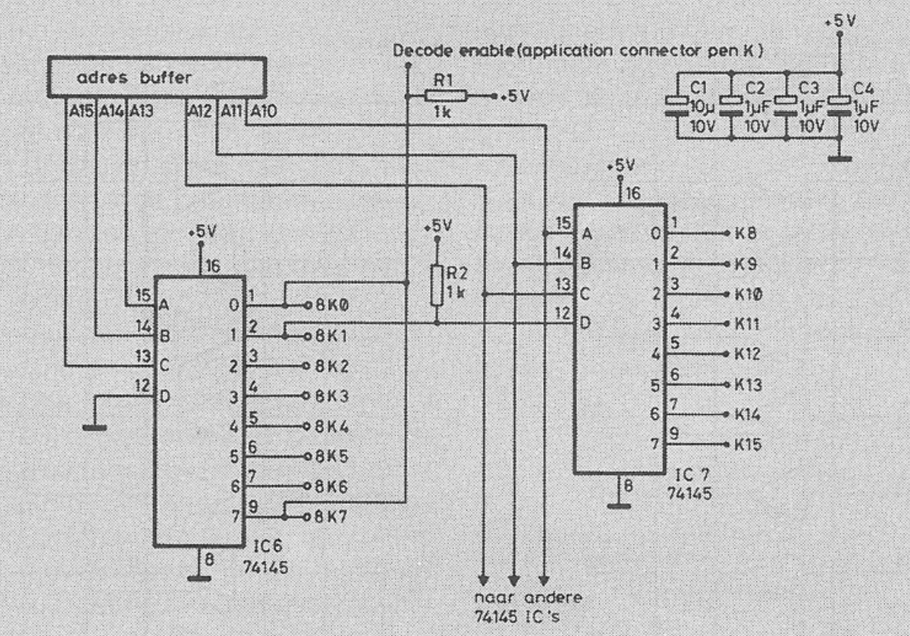
This was my second expansion, as described in this article.
With 4K RAM cards, 2114 SRAM based.
You see here A13, A14, A15 connected to a 74145 used as 3 to 8 decoder. Again the 74145 is used for its open collector outputs.
This delivers signals 8K0 to 8K7, where 8K0 selects 0000-1FFF, 8K1 2000-3FFF and so on, 8K7 selects E000-EFFF.
By tying signal 8K0 to 8K7 we repeat 0000-1FFF to E000-FFFF and the KIM-1 ROM vector is mapped in for a RESET. So we gain access to 2000-DFFF for expansion.
The second and third 74145 is an example to deliver Kx signals for 4KB memory parts. I added 32K SRAM this way with 8 4K RAM cards.
If you want access to address space E000-FFFF, you have to provide ROM at FFFA-FFFF, or map this address space to 17FA-17FF.
The same principles are used in the Micro-KIM and PAL-1 RAM card. and the PAL-2 full decode.
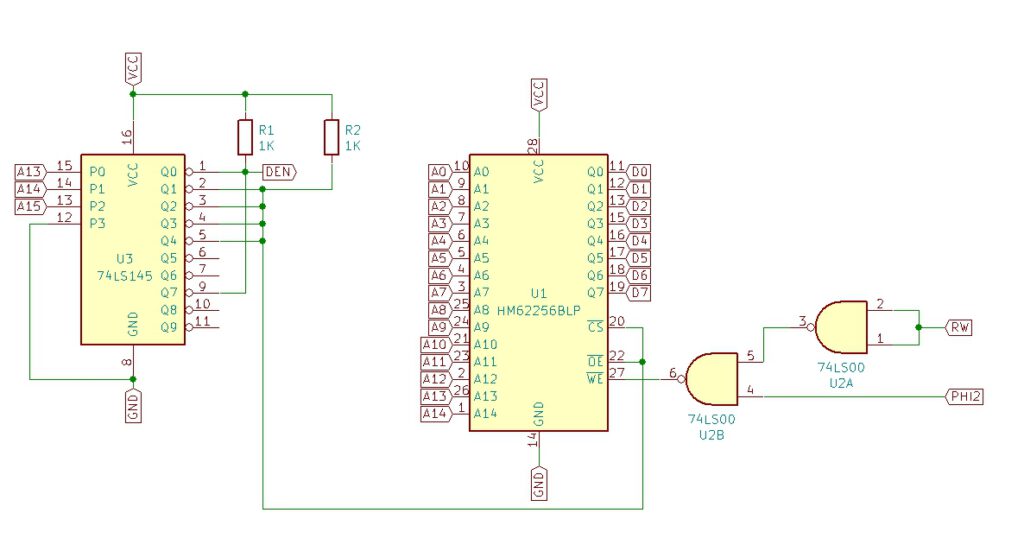
PAL-1 and Micro-KIM RAM board
PAL-2 decoder