
The KIM-1 has two methods of loading programs:
– from audio files on the audio interface
– from papertape from a papertape reader connected to the teletype terminal
Loading from papertape is something that comes for the old Teletype with papertape reader and punch.
It is therefore accessible with the ‘L’ command in the TTY CLI.
The routine will not work in LED display/hex keyboard mode, as GETCH does not work there.
0868   1DF7 C9 4C               CMP   #'L'       ; LOAD TAPE
0869   1DF9 F0 09               BEQ   LOADV

0874   1E04 4C E7 1C    LOADV   JMP   LOAD

0722   1CE7             ;
0723   1CE7             ;          LOAD PAPER TAPE FROM TTY
0724   1CE7             ;
0725   1CE7 20 5A 1E    LOAD    JSR   GETCH      ; LOOK FOR FIRST CHAR
0726   1CEA C9 3B               CMP   #$3B       ; SMICOLON
0727   1CEC D0 F9               BNE   LOAD
0728   1CEE A9 00               LDA   #$00
0729   1CF0 85 F7               STA   CHKSUM
0730   1CF2 85 F6               STA   CHKHI
0731   1CF4             ;
0732   1CF4 20 9D 1F            JSR   GETBYT     ; GET BYTE COUNT
0733   1CF7 AA                  TAX              ; SAVE IN X INDEX
0734   1CF8 20 91 1F            JSR   CHK        ; COMPUTE CHECKSUM
0735   1CFB             ;
0736   1CFB 20 9D 1F            JSR   GETBYT     ; GET ADDRESS HI
0737   1CFE 85 FB               STA   POINTH
0738   1D00 20 91 1F            JSR   CHK
0739   1D03 20 9D 1F            JSR   GETBYT     ; GET ADDRESS LO
0740   1D06 85 FA               STA   POINTL
0741   1D08 20 91 1F            JSR   CHK
0742   1D0B             ;
0743   1D0B 8A                  TXA              ; IF CNT=0 DONT
0744   1D0C F0 0F               BEQ   LOAD3      ; GET ANY DATA
0745   1D0E             ;
0746   1D0E 20 9D 1F    LOAD2   JSR   GETBYT     ; GET DATA
0747   1D11 91 FA               STA   (POINTL),Y ; STORE DATA
0748   1D13 20 91 1F            JSR   CHK
0749   1D16 20 63 1F            JSR   INCPT      ; NEXT ADDRESS
0750   1D19 CA                  DEX
0751   1D1A D0 F2               BNE   LOAD2
0752   1D1C E8                  INX              ; X=1 DATA RECORD
0753   1D1D             		         ; X=0 LAST RECORD
0754   1D1D 20 9D 1F    LOAD3   JSR   GETBYT     ; COMPARE CHKSUM
0755   1D20 C5 F6               CMP   CHKHI
0756   1D22 D0 17               BNE   LOADE1
0757   1D24 20 9D 1F            JSR   GETBYT
0758   1D27 C5 F7               CMP   CHKSUM
0759   1D29 D0 13               BNE   LOADER
0760   1D2B             ;
0761   1D2B 8A                  TXA              ; X=0  LAST RECORD
0762   1D2C D0 B9               BNE   LOAD
0763   1D2E             ;
0764   1D2E A2 0C               LDX   #$0C       ; X-OFF KIM
0765   1D30 A9 27       LOAD8   LDA   #$27
0766   1D32 8D 42 17            STA   SBD        ; DISABLE DATA IN
0767   1D35 20 31 1E            JSR   PRTST
0768   1D38 4C 4F 1C            JMP   START
0769   1D3B             ;
0770   1D3B 20 9D 1F    LOADE1  JSR   GETBYT     ; DUMMY
0771   1D3E A2 11       LOADER  LDX   #$11       ; X-OFF ERR KIM
0772   1D40 D0 EE               BNE   LOAD8

1141   1F91 18          CHK     CLC
1142   1F92 65 F7               ADC   CHKSUM
1143   1F94 85 F7               STA   CHKSUM
1144   1F96 A5 F6               LDA   CHKHI
1145   1F98 69 00               ADC   #$00
1146   1F9A 85 F6               STA   CHKHI
1147   1F9C 60                  RTS
1148   1F9D             ;
1149   1F9D             ;       GET 2 HEX CHAR'S AND PACK
1150   1F9D             ;       INTO INL AND INH
1151   1F9D                     X PRESERVED Y RETURNED = 0
1152   1F9D             ;       NON-HEX WILL BE LOADED AS NEAREST HEX EQU
1153   1F9D             ;
1154   1F9D 20 5A 1E    GETBYT  JSR   GETCH
1155   1FA0 20 AC 1F            JSR   PACK
1156   1FA3 20 5A 1E            JSR   GETCH
1157   1FA6 20 AC 1F            JSR   PACK
1158   1FA9 A5 F8               LDA   INL
1159   1FAB 60                  RTS
1160   1FAC             ;
1161   1FAC             ;       SHIFT CHAR IN A INTO
1162   1FAC             ;       INL AND INH
1163   1FAC             ;
1164   1FAC C9 30       PACK    CMP   #$30       ; CHECK FOR HEX
1165   1FAE 30 1B               BMI   UPDAT2
1166   1FB0 C9 47               CMP   #$47       ; NOT HEX EXIT
1167   1FB2 10 17               BPL   UPDAT2
1168   1FB4 C9 40               CMP   #$40       ; CONVERT TO HEX
1169   1FB6 30 03               BMI   UPDATE
1170   1FB8 18                  CLC
1171   1FB9 69 09               ADC   #$09
1172   1FBB 2A          UPDATE  ROL   A
1173   1FBC 2A                  ROL   A
1174   1FBD 2A                  ROL   A
1175   1FBE 2A                  ROL   A
1176   1FBF A0 04               LDY   #$04       ; SHIFT INTO I/O BUFFER
1177   1FC1 2A          UPDAT1  ROL   A
1178   1FC2 26 F8               ROL   INL
1179   1FC4 26 F9               ROL   INH
1180   1FC6 88                  DEY
1181   1FC7 D0 F8               BNE   UPDAT1
1182   1FC9 A9 00               LDA   #$00       ; A=0 IF HEX NUM
1183   1FCB 60          UPDAT2  RTS

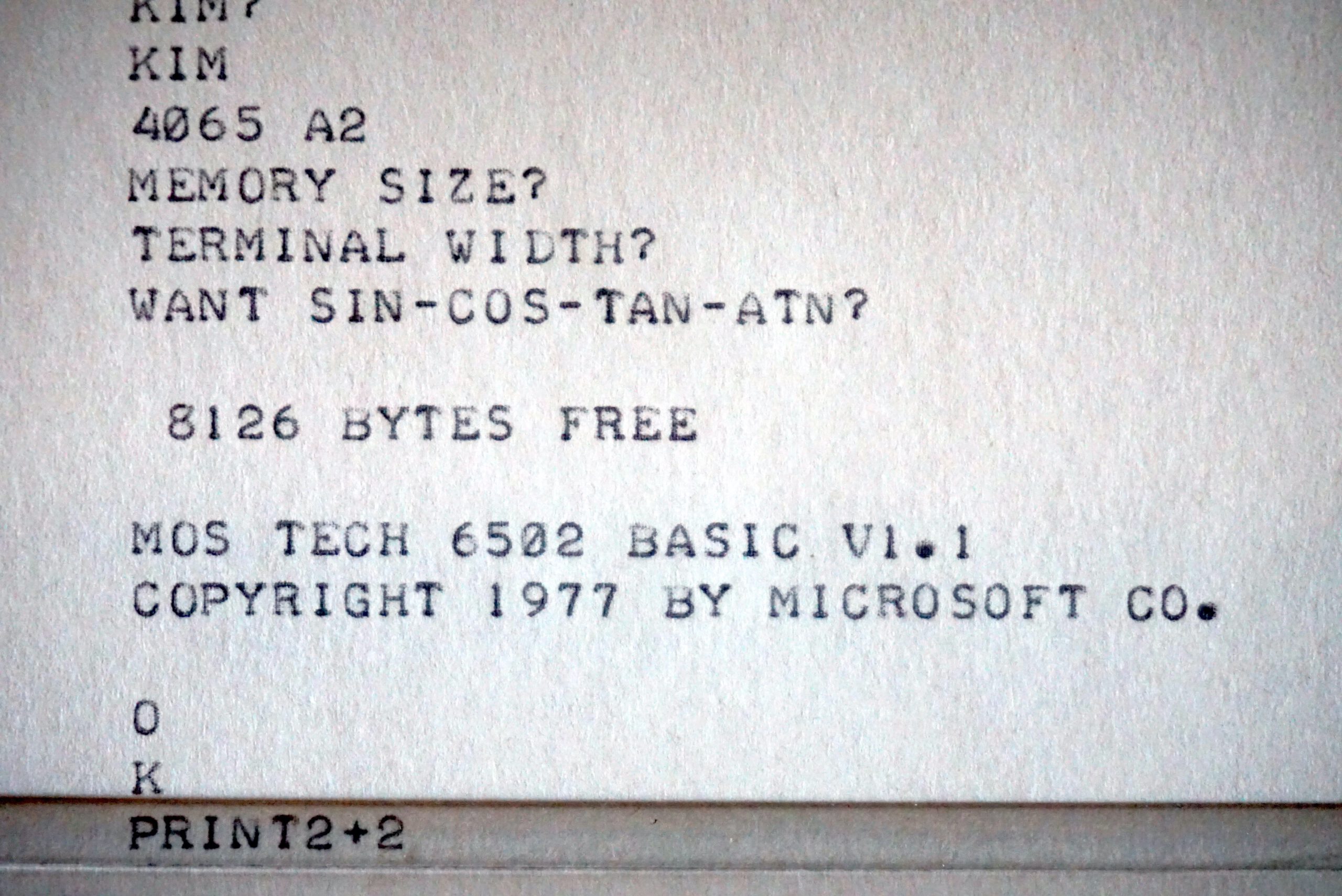
(Photos by Dave Wiliams with the MOS KIM-1 Reproduction connected to a Teletype)
Now papertape format is a special MOS Technology format, already used in the TIM-1. See the KIM-1 user manual for a technical description.
This is for example the papertape output captured with the KIM-1 S command for the memory test program in the Fist Book of KIM
;1800000000A900A885FA8570A2028672A50085FBA601A57049FF850B27
;1800187191FAC8D0FBE6FBE4FBB0F5A672A50085FBA570CA1004A20FF6
;1800300291FAC8D0F6E6FBA501C5FBB0ECA50085FBA672A571CA100F73
;18004804A202A570D1FAD015C8D0F0E6FBA501C5FBB0E8C67210AD0F29
;0B0060A57049FF30A184FA4C4F1C05CE
;0000050005
Load address, data and checksums are in the records.
A record is made up of:
‘;’ XX YYYY D..D CCCC
where
XX is number of databytes
YYYY is load address
D..D are XX databytes
CCCC is checksum, sum of XX YYYY and D.D)
What is happening in the code?
– a papertape record starts with a ‘;’, so line 725-727 look for that incoming to find start of a record, skipping any Null character if present
– the checksum is calculated per record, so cleared in 728 -730
– first two characters in record have byte count in record ($18 in examples above), 732-733 saved in X and added to checksum
– next the address to load the data in is read in and added to checksum (736-741)
– if count = 0 we are at the end of the papertape
– get the databytes in the record in a loop, add to checksum and store at load address (746-751)
– load checksum, compare to calculated checksum and report fatal error if not equal (754-759)
– continue loading records until last record (count 0 in X) (761-762)
– make input deaf via PB5 ($27 to SBD and print string KIM (0C)KIM and return (764-768)
error handling
– if low checksum wrong, read high checksum byte (770
– print string ERR KIM (771 -772) and return
CHK
– addition to 16 bit checksum, overflow ignored (1141-1147)
GETBYT
– read a character
– pack into byte
– read second character
– pack shift also into byte INL
PACK
– if char < '0' exit (1164)
- if char > ‘F’ exit (1166)
– if char <'A' add $09
- convert to binary (1172-1175)
- shift into INL (1176-1181)
- hex convert success with A = 0 (1182), not used here
The convert to binary works as follows:
'0' = $30
..
'9' = $39
'A' = $40 + $09 = $4A
..
'F' = $46 + $09 = $4F
So the shift of four leaves 0 .. F
Note that any non-hex character will load to checksum errors and are detected that way
Note also the null characters (value 00) inserted at the beginning of a papertape are discarded by the search for the ‘;’ starting character.
Multipart papertape format
The papertape format has in every record the address where to load the databytes. So you can have non-contiguous parts of memory loaded with one papertape file.
The Convert to hex 8 bit utility supports mulipart papertapes.
These can be loaded by the KIM-1 loader with no problems, since every record load address is read and used.
The KIM-1 Save to papertape can not produce multipart papertape files.