
This is my story about a first and a second version of KB-9 or, as it is officially called,
MOS Technology 6502, 9 DIGIT BASIC by MICROSOFT, Copyright 1977
MOS TECH 9 DIGIT BASIC FOR KIM COPYRIGHT 1977 BY MICROSOFT, 1977
Inside the binary you can find the version number: V1.1.
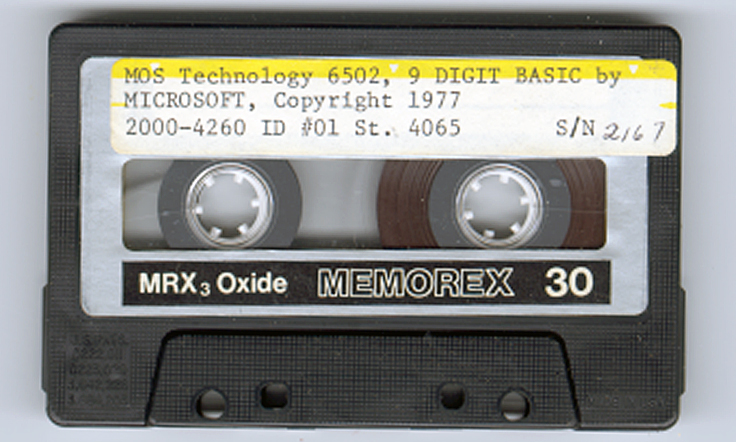
KB-9 cassette
In 1978 I bought KB-9 for my KIM-1. It came from Johnson Computers, a distributor for Microsoft.
I had just upgraded the memory and had built a simple video terminal (32 characters, 24 lines, uppercase only).
As you can see in the image above, it was serial number 2167, ID 01, $2000-$4260, starting at $4065.
Reading the tape into my KIM-1 was quite a task. I had to adjust the azimuth of the player head for a sharp-pitched sound, tune the PLL on the KIM-1 and adjust the volume during reading, since part of the tape was quite soft in the middle. The recording was in the normal KIM-1 audio format, so it took a long time to load!
After many tries I had it in memory without loading errors and immediately made a new recording. In hindsight, I recorded a bit more memory than required; there are unused data bytes at the end of this dump. This backup tape was recorded in Hypertape 6x, which loads much faster. The backup tape was stored safely and a working copy was used to play with BASIC.
Fast forward to 2004.
My KIM-1 had not been used as my main computer since 1985, but I had kept many of the audio cassettes. With a quality audio cassette recorder and a high-quality sound card in my PC, I dumped all the cassettes to WAV files on the PC. The format is 22050 Hz, 8-bit mono, uncompressed. I chose this format because I had found a DOS utility called KIMTAPE, written in Ed’s DX-Forth, that could convert a WAV file to binary and the other way around. It worked well, and I now had all the cassettes I had kept in binary format.
tape:    tones 2455/3238 Hz, bit 1,38 ms, HYPERTAPE 6x

Program 01  address 2000  checksum OK  8816 bytes
As you can see, the dump is 8816 bytes, while the original recording, $2000-$4260, is $2261 = 8801 bytes. That is 15 bytes too many, recorded by me! These extra bytes are in all binaries of KB-9 on the internet …
My tape collection is the origin of many programs that are now available and can run on the KIM-1 and its clones.
All KB-9 versions floating around the web come from this backup cassette dump I made. The first time it showed up was when Vince Briel made the MicroKIM; my website was already up and (with my help) he added KIM-1 software to the kit.
Another place it showed up is the excellent Create your own Version of Microsoft BASIC for 6502 by Michael Steil: a disassembled, commented and rebuildable source of many early Microsoft BASICs for the 6502, including my KIM-1 KB-9.
Derivatives of KB-9 V1.1 were now easy to make, so V1.2 and V2.0 are now the best versions to run on the KIM-1.
2026, a second dump of KB-9!
I had never seen another dump of KB-9. A photo of an audio cassette showed up, but there was no recording to dump. More versions of the manual, yes, but the tapes were lost.
Until this summer! My friend Gerben Voort found an Elektor Junior, and with it came some audio cassettes. One of them is a KB-9 tape!
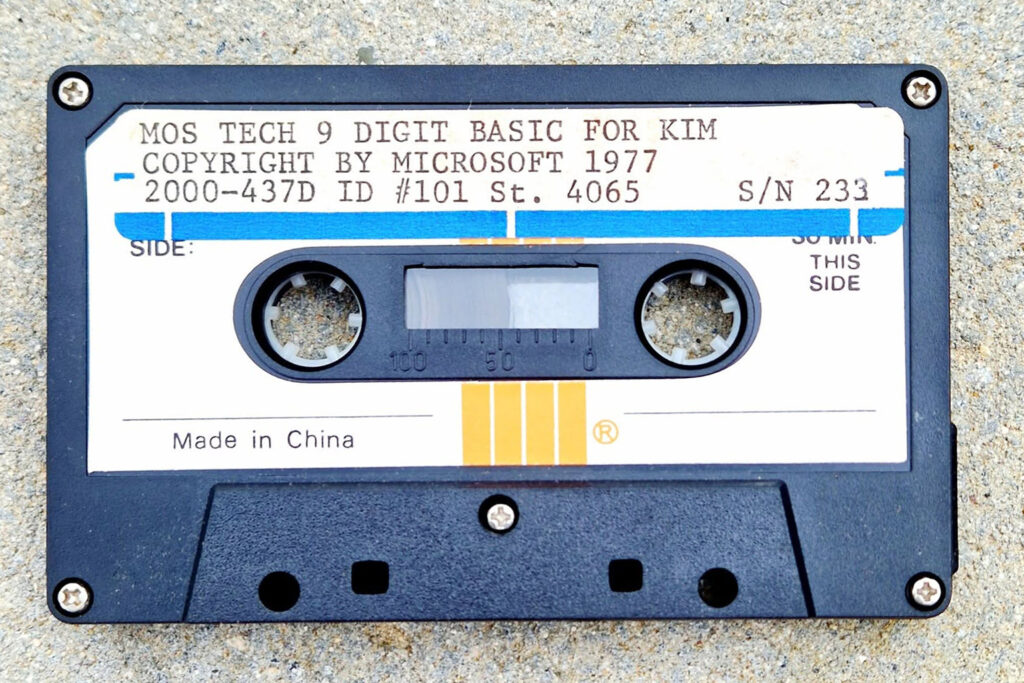
The label states $2000-$437D, which is larger than my original version. Is that a different version?
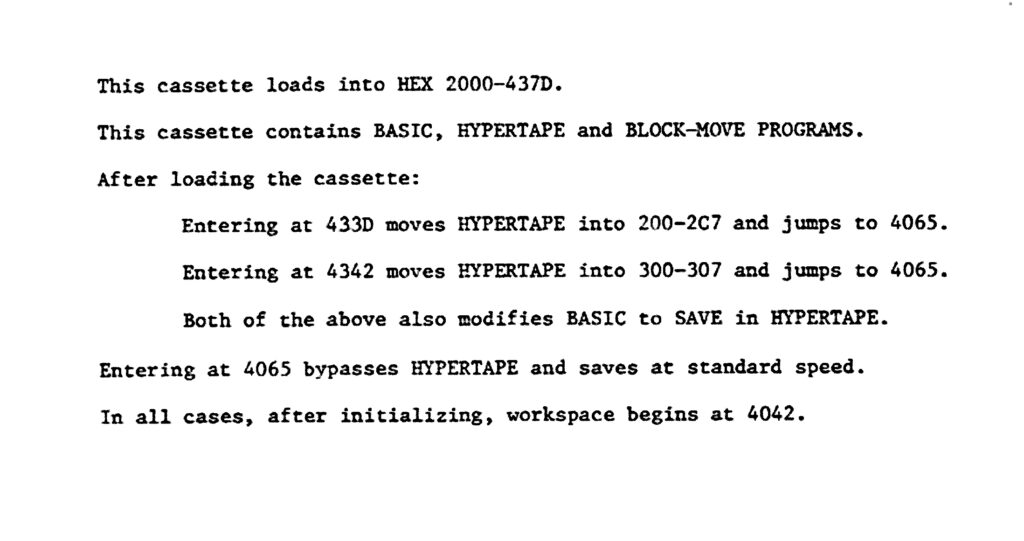
The manual has an extra page I had not seen before! Hypertape support? This must be a later version than mine? But the start location is the same as the original if you do not want Hypertape?
In October I visited Gerben and he lent me the tape. I also got a cassette player.
Then I spent several days dumping the tape directly to the PC as a WAV file. I fought with dirty recorder heads, with the PC resetting the microphone input options (which did horrible things to the audio), and with learning Audacity to export a WAV file suitable for the old KIMTAPE running in DOSBox (it is too old for a modern PC). And it kept on failing!
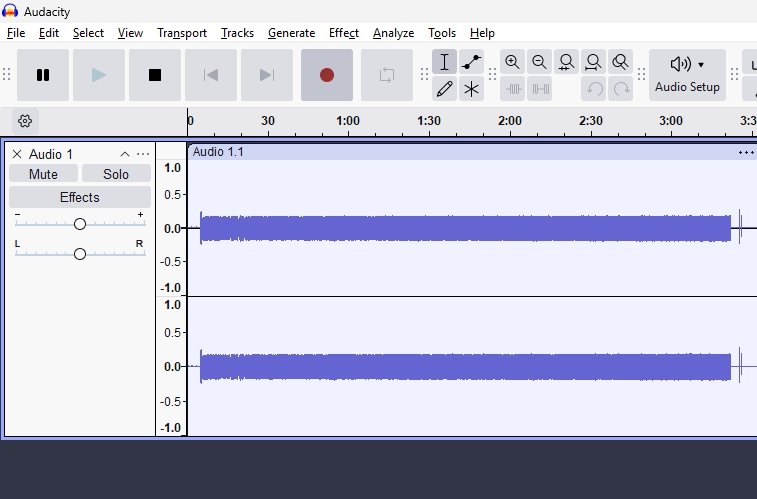
So I made a new version of KIMTAPE in Free Pascal. It is also a command-line utility, but cross-platform, and with much more powerful routines to detect the bytes in the audio.
In the end, a combination of three different recordings on two PCs, varying volume and tone control, and the power of the new KIMTAPE resulted in a dump with a correct checksum.
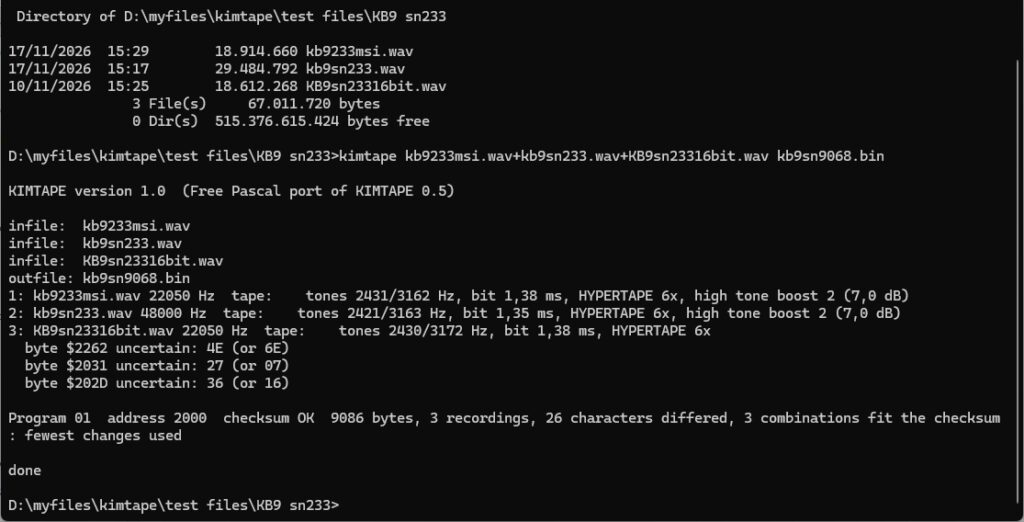
The second dump
I named the second dump KB9SN233. I loaded it into the KIM-1 Simulator and it runs. It is the same version, V1.1.
The next step was to see what had changed. WinMerge showed the differences between the two versions. As expected, KB9SN233 has extra bytes at the end.
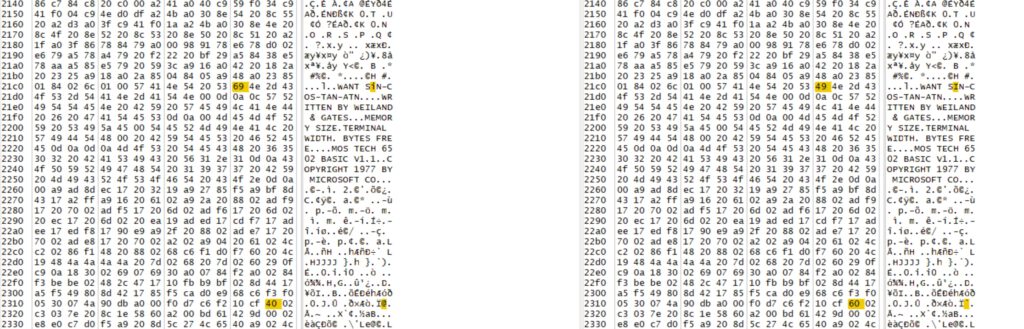
But as you can see, two other bytes were different. Both had bit 5 flipped. The checksum was OK, but the two bytes were wrong.
The first was in the text SiN, which had to be SIN (uppercase I instead of lowercase i). The second, further on, was $40 (RTI), which had to be $60 (RTS) in the Hypertape return (the full source is shown later).
Flipping these bits back made sense: the checksum calculation in KIM files does not detect these errors, because one flip adds $20 and the other subtracts $20, so they cancel out. KIMTAPE was happy with the repaired dump and its good checksum.
The BEQ/BNE bug
There is another byte that differs between the two versions: at location $2AEE, KB9SN233 has F0 instead of D0. This is not a reading error but a deliberate patch in this version.
From the pagetable source:
; BUG: The beq/bne L2AF8 below is supposed
; to be always taken. For this to happen,
; the last load must be a 0 for beq
; and != 0 for bne. The original Microsoft
; code had ldx/ldy/bne here, which was only
; correct for a non-ZP INPUTBUFFER. Commodore
; fixed it in CBMBASIC V1 by swapping the
; ldx and the ldy. It was broken on KIM,
; but okay on APPLE and CBM2, because
; these used a non-ZP INPUTBUFFER.
; Microsoft fixed this somewhere after KIM
; and before MICROTAN, by using beq instead
; of bne in the ZP case.
My V1.1 KB-9 for the KIM-1 has this bug. In KB9SN233 the bug has been fixed!
Conclusion: apart from the BNE/BEQ bugfix and the extra code at the end, KB9V11AA and KB9SN233 are identical from $2000 to $4260!
The extra code
I disassembled the extra code after $4260. It consists of a template Hypertape routine, a patch to the JSR $1800 (the KIM audio dump routine) at $27EE, a routine that moves Hypertape to $0200 or $0300, and patches to Hypertape for the page it lands on.
See the KB-9 page for the dumps and the source code of the Hypertape extension.