
A collection of articles about the KIM-1, original Dutch, here in English and with source and binary of the programs.
The original articles were scanned. converted back to text with OCR and translated to English.
The documents in Dutch and English are published new in PDF format.
If a program listing was included the assembler source is reconstructed in modern MOS Technology syntax. The binary output is compared to the printed binary code and a papertape formatted binary is included.
This is a work in progress. Each article takes half a day of work. See the page on Radio Bulletin articles of candidates to be processed later.
Downloads available for every article are:
– the original scanned article in Dutch
– the Dutch OCR’ed and recreated article
– the English translated form the OCR result and recreated article
– an archive with source and binary
Mastermind on the KIM
You are probably familiar with the well-known game Mastermind. Normally this game is played by two people, with only one person actively trying to guess a hidden code. The second person has the passive task of indicating, with black and white pegs, whether the chosen colours are correct and whether they are in the right positions. Replace the colours with digits, the black and white pegs with letters, and the KIM takes the place of the passive player. At your command, it chooses a secret colour combination and uses letters to indicate how many digits have been correctly guessed. A special “cheat button” makes it possible to peek secretly behind the screen; the consequence, however, is that the turn counter is increased by 30 points.
Runs on the unexpanded KIM-1 with keypad and seven segment display
 |
Mastermind on the KIM Radio Bulletin 1977 original scan |
|
Mastermind on the KIM Radio Bulletin 1977 English |
|
Mastermind on the KIM Radio Bulletin 1977 Dutch |
 |
Mastermind source and binary |
Morse decoding with the KIM
It may be quite nice to be able to say that you are the owner of a microcomputer (if things continue as they are now, in a few years this will be just as commonplace as owning a pocket calculator is today), but even nicer is to also own programs and to be able to spend a number of useful and above all pleasant hours with the device. The following program, written for the KIM, may contribute to this. It makes it possible to display received Morse signals as ‘readable writing’ on the KIM display. Although with a seven-segment display by no means all letters and punctuation marks can be formed, and therefore certain symbols had to be found for these characters, after some practice it is quite possible to read messages sent in Morse code from the display. The program can be used not only for displaying received messages, but also for practising sending and for checking the sending technique. From what is shown on the display one can determine what mistakes are being made while sending
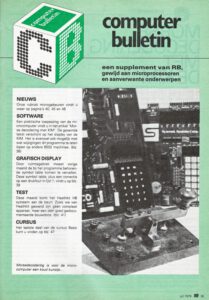 |
Morse decodering met de KIM July Augustus 1979 original scan |
| Morse decoding with the KIM Aug 79 Radio Bulletin |
|
|
|
|