
 Kenner 2 page 4 July 1977 Co Filmer, translated to english Hans Otten, 2021
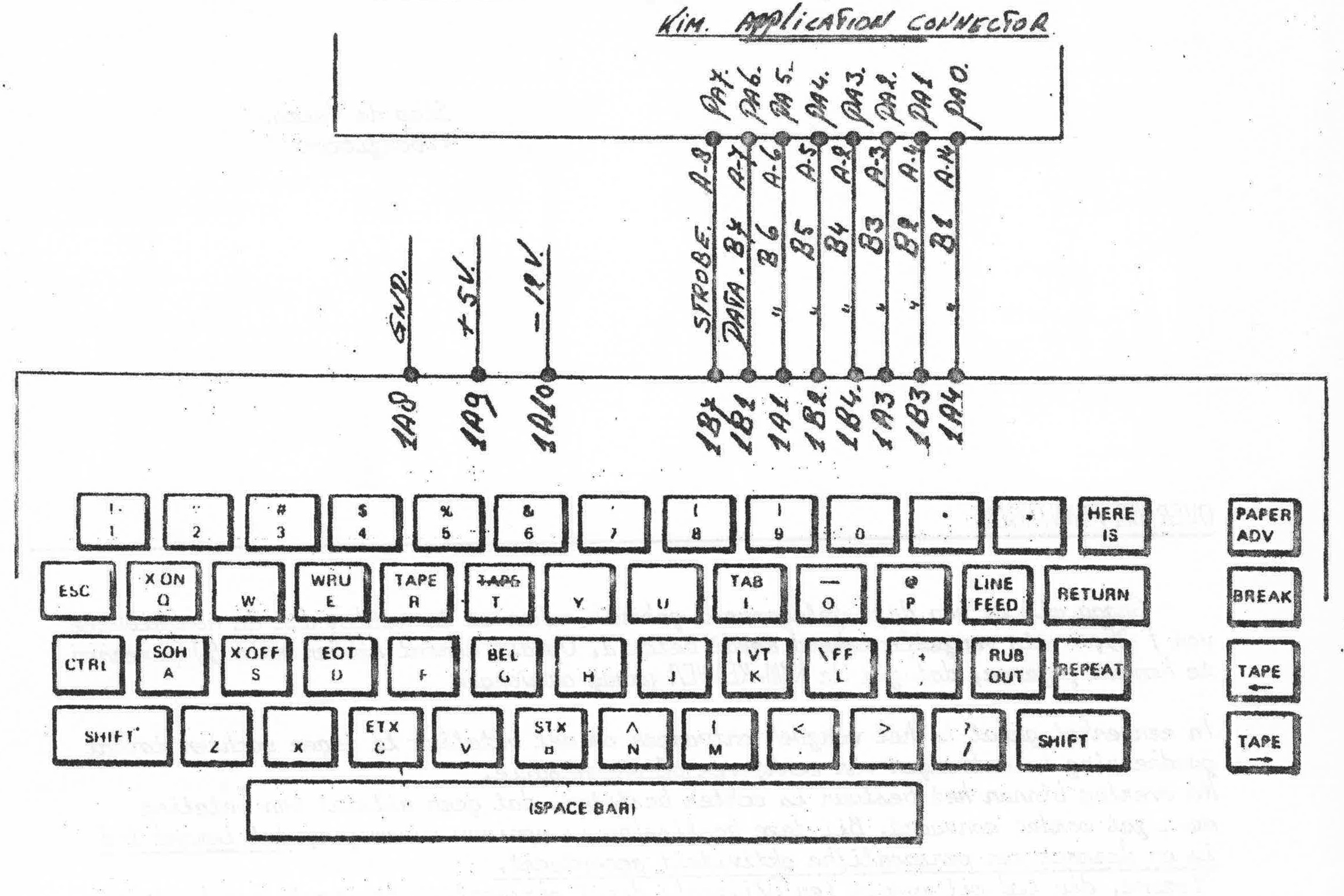
A parallel ASCII keyboard is a nice addition to the KIM-1.
Connect to the PIA A of the KIM-1 on the Application connector.
Some keyboards may require a -12 V power supply.
The address 1700 now shows the ASCII keyboard code of (the last) key pressed. The high bit (PB7) is the strobe signal, the other 7 bits the ASCII code.
A program should poll the strobe bit, if activated wait for the strobe bit to be deactivated, and then read the key and return.
Testing for keypressed such as a break test means checking the strobe bit, if activated stop processing, etc..
Code fragments by Hans Otten
PAD * $1700 ; BREAKKEY IN BIT 7
   ; SUBROUTINE GET CHARACTER
   ;
GETCH BIT PAD ; PROCEDURE GETCHARACTER ( CHAR )
 BPL GETCH ;   WAIT FOR STROBE
GWAIT BIT PAD ;   WAIT FOR END OF STROBE
 BMI GWAIT ;
 LDA PAD ;   GET CHARACTER
 RTS  ; END GETCHARACTER
   ;
   ; example of break test
   ;
SYN BIT PAD ;   REPEAT
 BPL GOON ;     WHILE NOT keypressed
 JMP MONRET ;
GOON continue processing
See also:
Replica 1 TE PAL version
User ExPLIT on the German forum Verein zum Erhalt klassischer Computer e.V.
has build an Apple 1 Replica 1 TE from th...
Jolt with 4K and power supply
With thanks to Jonathan Chapman of Glitchworks who found a Jolt system, here images of a Jolt with 4K memory, an experim...
TERC KIM-1 Interface set
A recent acquisition, the TERC (Technical Education Research Centers) KIM-1 Interface set. An educational tool to work w...
6502 tester NMOS CMOS 1-8MHz
The 6502 W65C02 6502C CPU tester NMOS / CMOS 1-8MHz is a CPU tester for 40 pin 6502/65C02 and WD65C02 and Sally.
The...