
By Bob Applegate
Adding I/O devices that don’t need much address space. On the KIM-1, the space from 1400-17FF is grouped into the K0 block but only 17xx are used, leaving 1400-16FF open for use. To decode that range into four blocks of 256 bytes is easy using a single chip and a few signals from the KIM Clone expansion bus:
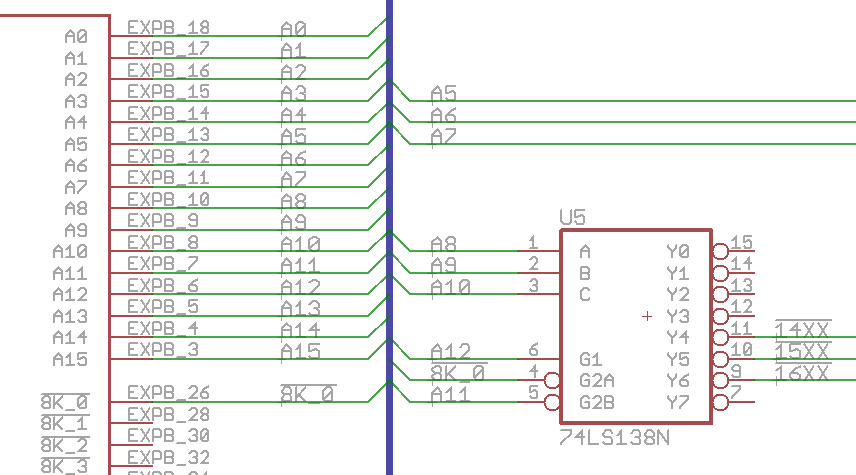
Everyone has a 74LS138 in their parts collection, so just connect a few signals from the expansion bus and use one of the three signals from the 138 to decode which block you want to use. Use the A0-A7 address lines to decode into smaller pieces.
See also:
Replica 1 TE PAL version
User ExPLIT on the German forum Verein zum Erhalt klassischer Computer e.V.
has build an Apple 1 Replica 1 TE from th...
Jolt with 4K and power supply
With thanks to Jonathan Chapman of Glitchworks who found a Jolt system, here images of a Jolt with 4K memory, an experim...
TERC KIM-1 Interface set
A recent acquisition, the TERC (Technical Education Research Centers) KIM-1 Interface set. An educational tool to work w...
6502 tester NMOS CMOS 1-8MHz
The 6502 W65C02 6502C CPU tester NMOS / CMOS 1-8MHz is a CPU tester for 40 pin 6502/65C02 and WD65C02 and Sally.
The...